The Bible tells us that Samuel died and was buried in Ramah, with all Israel mourning him. But it does not give a specific cause of death. The account is brief and simple.
The main verse about Samuel’s death is 1 Samuel 25:1. It says:
“Now Samuel died, and all Israel assembled and mourned for him; and they buried him near his home in Ramah.”
That is all the Bible directly says about his death. No illness is mentioned. No accident. No violence. The focus is not on how he died but on the fact that he died and was deeply mourned by the entire nation.
Let us look more closely at what the Bible does and does not tell us about Samuel’s death.
How Did Samuel Die in the Bible?
Samuel’s Death in 1 Samuel 25:1
The Bible records Samuel’s death in one verse. 1 Samuel 25:1 gives us three clear facts:
- Samuel died.
- All Israel gathered to mourn him.
- He was buried in Ramah, his hometown.
The verse also tells us what happened next: David left and went down to the Desert of Paran.
The fact that all Israel mourned shows how much the people respected Samuel. He had served as a prophet, judge, and spiritual leader for many years. His death marked the end of a very important time in Israel’s history.
The Bible does not describe his final moments. It does not say who was with him or what his last words were. The record is short and direct.
What Was the Cause of Samuel’s Death?
The Bible never tells us exactly how Samuel died.
Scripture does not mention:
- A sickness or disease
- A battle or wound
- An accident
- An execution
- Any kind of violence
Because the Bible gives no reason to think his death was unusual, most readers and Bible scholars understand that Samuel died a natural death at an old age.
One commentary puts it this way: “It is not said how Samuel died. The Holy Ghost hath thought it enough to record his death, without subjoining anything more.”
Samuel had lived a long life of faithful service. He had completed the work God gave him. He had anointed both Saul and David as kings. By the time of his death, his main ministry was finished.
The Bible’s silence on the cause of death is not an accident. The Scriptures often spend less time describing how God’s servants died and more time showing how they lived. Samuel’s story follows that pattern. His legacy was not defined by the way he died but by a lifetime of obedience to God.
So the honest answer to the question is this: the Bible does not say what caused Samuel’s death. We can reasonably conclude it was a natural death in old age, but Scripture does not confirm that directly.
How Old Was Samuel When He Died?
The Bible does not tell us Samuel’s exact age at death.
Unlike some other biblical figures—such as Abraham (175 years), Moses (120 years), or Joshua (110 years)—Samuel’s age is not recorded.
Many Bible commentators and historians have tried to estimate his age. Here are some of the common guesses:
- Some say he was about 98 years old.
- Others suggest he lived to be around 100.
- Some Jewish traditions say he died at age 54, but this is not widely accepted.
- One source notes that “all this is very uncertain.”
These numbers are only estimates. They are based on trying to calculate dates and timelines from other events in the Bible. But the Bible itself gives no exact number.
What we do know is that Samuel lived a long life of service. He began serving the Lord as a young boy under Eli’s guidance. He later served as Israel’s judge and prophet for many years. He anointed the first two kings of Israel. By the time he died, he was likely an elderly man.
The Bible’s focus is not on Samuel’s age but on his faithfulness. That is the lesson that matters most.
Where Was Samuel Buried?
Samuel was buried in Ramah, his hometown.
1 Samuel 25:1 says he was buried “at his home in Ramah” or “near his home in Ramah.”
Ramah was the town where Samuel lived and served. It was located in the hill country of Ephraim. Some Bible experts believe Ramah may be the same place as Ramathaim-Zophim, where Samuel was born (1 Samuel 1:1).
The phrase “in his house” does not necessarily mean inside the building where he lived. In ancient Israel, families often had burial places on their property. One commentary explains that it likely means “his own mausoleum” or family tomb. Another notes it could mean “the house in which he lived, with the court belonging to it, where Samuel was placed in a tomb erected especially for him.”
Being buried in his hometown shows that Samuel was honored and remembered by his own people. It also shows that he remained connected to his home and community until the end.
Did Samuel Die Before David Became King?
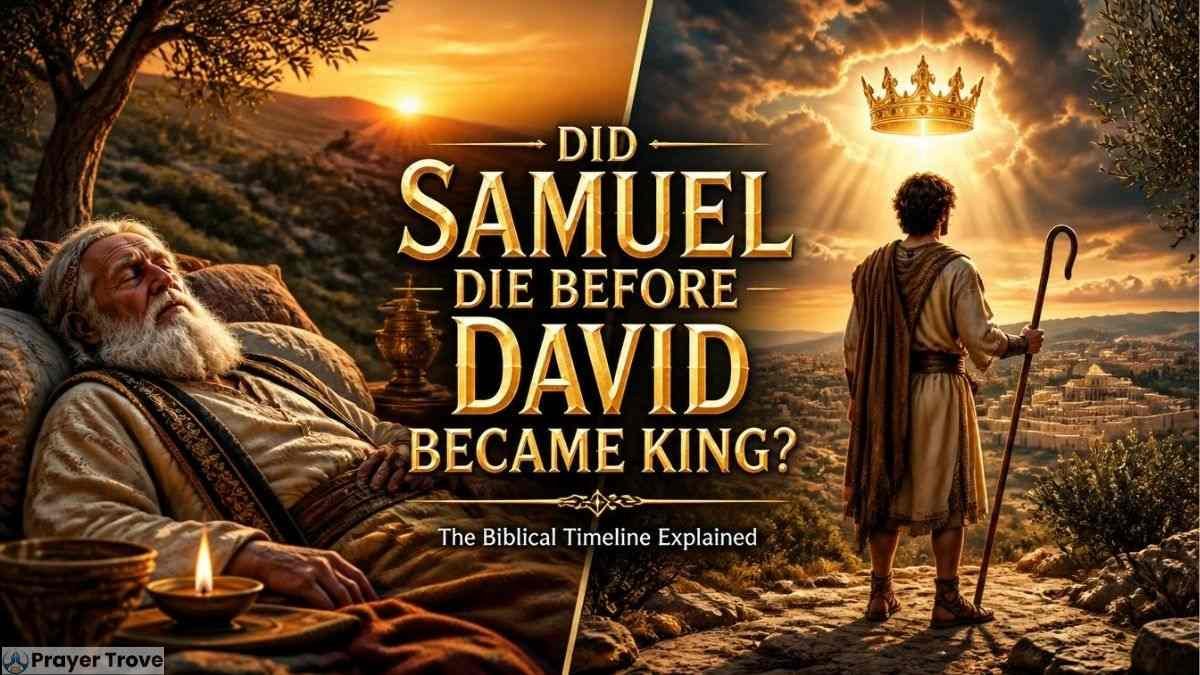
Yes, Samuel died before David became king over Israel.
This is an important point. Many people assume Samuel lived to see David take the throne. But that is not what the Bible shows.
Samuel anointed David as the future king while Saul was still ruling. 1 Samuel 16:13 says:
“So Samuel took the horn of oil and anointed him in the presence of his brothers, and from that day on the Spirit of the Lord came powerfully upon David.”
Samuel did what God asked him to do. He identified God’s chosen king and anointed him. But David did not become king right away. He spent many years running from Saul, facing hardship, and waiting for God’s timing.
By the time Samuel died in 1 Samuel 25:1, David had been anointed but had not yet taken the throne. Saul was still king. David was still a fugitive.
Samuel’s role was to prepare the way, not to see the fulfillment. He trusted God to complete what He had started.
What Happened Before Samuel Died?
Samuel’s final years were marked by some of the most important events in Israel’s history.
He anointed Saul as the first king. God chose Saul, and Samuel anointed him (1 Samuel 10:1). Samuel guided Saul in his early days as king.
He confronted Saul’s disobedience. When Saul disobeyed God’s command about the Amalekites, Samuel delivered a painful message. He said:
“You have rejected the word of the Lord, and the Lord has rejected you as king over Israel” (1 Samuel 15:26).
Samuel grieved over Saul’s failure. He cried out to the Lord all night (1 Samuel 15:11). He cared deeply for the king he had anointed, even when that king had turned away from God.
He anointed David as the next king. After God rejected Saul, He sent Samuel to Bethlehem to anoint David (1 Samuel 16:1-13). This was one of Samuel’s final and most important acts.
He gave a farewell address. In 1 Samuel 12, Samuel spoke to all Israel. He reminded them of God’s faithfulness and called them to obey the Lord. He said, “I am old and gray” (1 Samuel 12:2). This was his last major recorded speech.
After these events, Scripture records no major public ministry from Samuel. The story shifts its focus to Saul’s decline and David’s rise.
What Happened After Samuel Died?
After Samuel died, Israel lost its great prophet and judge. But God’s plan continued.
David went down to the Desert of Paran (1 Samuel 25:1). He continued to face trials and dangers. Saul remained king for a while longer.
One of the most striking events after Samuel’s death is found in 1 Samuel 28.
Samuel and the Medium of Endor
Near the end of Saul’s life, the Philistines gathered to fight against Israel. Saul was terrified. He tried to get guidance from God, but God did not answer him—not through dreams, not through prophets, not through the Urim (1 Samuel 28:6).
In desperation, Saul went to a medium at Endor. He asked her to bring up the spirit of Samuel (1 Samuel 28:7-11).
The medium saw Samuel and cried out. Samuel appeared and spoke to Saul. He told Saul that because he had disobeyed God, the kingdom would be taken from him. He also told Saul that he and his sons would die in battle the next day (1 Samuel 28:16-19).
This passage raises many questions. Was this really Samuel? Or was it something else? The Bible does not fully explain. What is clear is that Samuel’s words came true: Saul and his sons died in battle, just as Samuel had said.
This event shows that even after his death, Samuel’s words still carried weight. His prophetic message continued to speak to Israel.
What Bible Verses Mention Samuel’s Death?
Several verses in the Bible refer to Samuel’s death:
- 1 Samuel 25:1 – The main account of Samuel’s death, mourning, and burial.
- 1 Samuel 28:3 – A reminder that Samuel had died and was buried in Ramah.
- 1 Samuel 28:15-19 – The appearance of Samuel’s spirit to Saul, delivering a message of judgment.
These verses together show that Samuel’s death was a significant event. The nation mourned him. And his influence continued even after he was gone.
Why Was Samuel’s Death Important to Israel?
Samuel’s death was important for several reasons.
He was the last of the judges. Samuel served as a judge over Israel (1 Samuel 7:15-17). With his death, the period of the judges came to an end. Israel was now fully entering the era of kings.
He was a prophet who spoke for God. Samuel was faithful to God’s Word. He did not compromise. He spoke the truth, even when it was hard. His death left a void in Israel’s spiritual leadership.
He anointed Israel’s first two kings. Samuel was the one who set up the monarchy. He anointed Saul and then David. His work prepared the way for the great king David, through whom God’s covenant would continue.
His death marked a turning point. With Samuel gone, Israel entered a new chapter. Saul’s kingdom was declining. David was waiting to rise. The nation was in transition.
Samuel’s death was a loss for Israel. But God was still at work. The Lord who had called Samuel continued to guide His people.
Did Saul Kill Samuel?
No, Saul did not kill Samuel.
There is no record in the Bible of Saul harming Samuel. In fact, Saul and Samuel had a complicated relationship. Samuel anointed Saul as king. But later, Saul disobeyed God, and Samuel confronted him. Samuel grieved over Saul’s failure. But he did not die at Saul’s hand.
Some people may wonder about this because of the story in 1 Samuel 28. In that chapter, Saul seeks out a medium to contact Samuel after Samuel has already died. This shows that Samuel was already dead and buried before Saul consulted the medium.
Saul did not kill Samuel. Samuel died a natural death, and Saul later tried to speak with him from beyond the grave.
Conclusion
So, how did Samuel die in the Bible?
The simple answer is this: Samuel died, all Israel mourned him, and he was buried in Ramah (1 Samuel 25:1). The Bible does not tell us the specific cause of his death. It does not mention an illness, an injury, or any unusual event. Most readers understand that he died a natural death at an old age, after a long life of faithful service.
What stands out most in Samuel’s story is not how he died but how he lived. He served God from childhood. He spoke the truth, even when it was hard. He helped guide Israel through one of the most important transitions in its history. He anointed the kings who would shape the future of God’s people.
The Bible’s silence on the details of Samuel’s death is a reminder that a person’s legacy is not measured by the way they die, but by the way they live. Samuel’s example challenges us to be faithful, obedient, and courageous—no matter what comes.
Frequently Asked Questions
What happened to Samuel in the Bible?
Samuel was a prophet, judge, and spiritual leader in Israel. He served God faithfully from childhood. He anointed Israel’s first two kings, Saul and David. He died and was buried in Ramah, and all Israel mourned him (1 Samuel 25:1).
How did Samuel die in the Bible according to the KJV?
The King James Version says: “And Samuel died; and all the Israelites were gathered together, and lamented him, and buried him in his house at Ramah” (1 Samuel 25:1). It does not mention any specific cause of death.
Did Samuel die after confronting Saul?
Yes. Samuel confronted Saul about his disobedience, anointed David as the next king, and died sometime after those events.
What were Samuel’s last words in the Bible?
The Bible does not record Samuel’s final words at the moment of death. His last major recorded speech is found in 1 Samuel 12, where he gave a farewell address to Israel.
Did David go to Samuel’s funeral?
The Bible does not say specifically whether David attended Samuel’s funeral. It records that all Israel mourned and buried Samuel. David was likely among those who grieved, but Scripture does not confirm his presence.