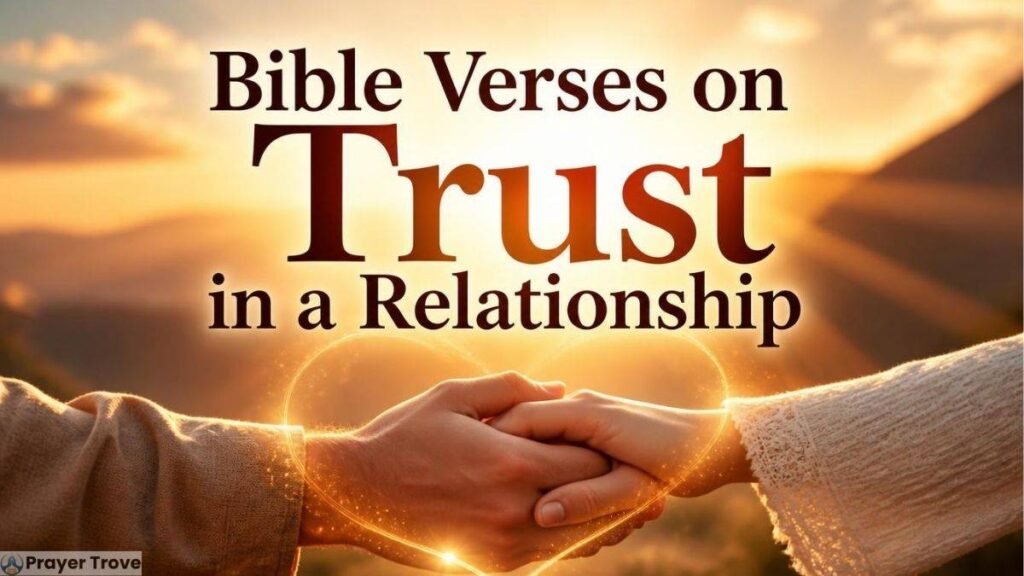
Trust is the foundation of every strong relationship. Without it, love cannot grow. The Bible has a lot to say about trust—how to build it, how to protect it, and how to keep it strong through hard times. These verses speak about honesty, loyalty, patience, and faith in God. They help couples, friends, and family members learn to rely on each other healthily. Here are key Bible verses on trust in a relationship and what each one means for your daily life.
Proverbs 3:3-4
“Let not steadfast love and faithfulness forsake you; bind them around your neck; write them on the tablet of your heart. So you will find favor and success in the sight of God and man.”
Proverbs 3:5-6
“Trust in the Lord with all your heart, and do not lean on your own understanding. In all your ways acknowledge him, and he will make straight your paths.”
Proverbs 11:13
“Whoever goes about slandering reveals secrets, but he who is trustworthy in spirit keeps a thing covered.”
Proverbs 12:22
“Lying lips are an abomination to the Lord, but those who act faithfully are his delight.”
Proverbs 17:17
“A friend loves at all times, and a brother is born for adversity.”
Proverbs 18:22
“He who finds a wife finds a good thing and obtains favor from the Lord.”
Proverbs 18:24
“A man of many companions may come to ruin, but there is a friend who sticks closer than a brother.”
Proverbs 27:17
“Iron sharpens iron, and one man sharpens another.”
Proverbs 31:10-11
“An excellent wife who can find? She is far more precious than jewels. The heart of her husband trusts in her, and he will have no lack of gain.”
Proverbs 31:28
“Her children rise up and call her blessed; her husband also, and he praises her.”
Ecclesiastes 4:9-10
“Two are better than one, because they have a good reward for their toil. For if they fall, one will lift his fellow. But woe to him who is alone when he falls and has not another to lift him!”
Ecclesiastes 7:8-9
“Better is the end of a thing than its beginning, and the patient in spirit is better than the proud in spirit. Be not quick in your spirit to become angry, for anger lodges in the bosom of fools.”
Song of Songs 2:16
“My beloved is mine, and I am his.”
Song of Songs 4:7
“You are altogether beautiful, my darling; there is no flaw in you.”
Song of Songs 8:6-7
“Set me as a seal upon your heart, as a seal upon your arm, for love is strong as death, jealousy is fierce as the grave. Its flashes are flashes of fire, the very flame of the Lord. Many waters cannot quench love, neither can floods drown it.”
Genesis 2:18
“Then the Lord God said, ‘It is not good that the man should be alone; I will make him a helper fit for him.'”
Genesis 2:24
“Therefore a man shall leave his father and his mother and hold fast to his wife, and they shall become one flesh.”
Ruth 1:16-17
“But Ruth said, ‘Do not urge me to leave you or to return from following you. For where you go I will go, and where you lodge I will lodge. Your people shall be my people, and your God my God. Where you die I will die, and there will I be buried. May the Lord do so to me and more also if anything but death parts me from you.”
Psalm 37:5
“Commit your way to the Lord; trust in him, and he will act.”
Psalm 55:22
“Cast your burden on the Lord, and he will sustain you; he will never permit the righteous to be moved.”
Psalm 118:8-9
“It is better to take refuge in the Lord than to trust in man. It is better to take refuge in the Lord than to trust in princes.”
Matthew 7:12
“So in everything, do to others what you would have them do to you, for this sums up the Law and the Prophets.”
Matthew 6:34
“Therefore do not be anxious about tomorrow, for tomorrow will be anxious for itself. Sufficient for the day is its own trouble.”
John 13:34-35
“A new commandment I give to you, that you love one another: just as I have loved you, you also are to love one another. By this all people will know that you are my disciples, if you have love for one another.”
John 15:12-13
“This is my commandment, that you love one another as I have loved you. Greater love has no one than this, that someone lay down his life for his friends.”
Romans 5:8
“But God shows his love for us in that while we were still sinners, Christ died for us.”
Romans 12:9-10
“Let love be genuine. Abhor what is evil; hold fast to what is good. Love one another with brotherly affection. Outdo one another in showing honor.”
Romans 12:18
“If possible, so far as it depends on you, live peaceably with all.”
1 Corinthians 13:4-7
“Love is patient and kind; love does not envy or boast; it is not arrogant or rude. It does not insist on its own way; it is not irritable or resentful; it does not rejoice at wrongdoing, but rejoices with the truth. Love bears all things, believes all things, hopes all things, endures all things.”
1 Corinthians 13:13
“So now faith, hope, and love abide, these three; but the greatest of these is love.”
Galatians 5:22-23
“But the fruit of the Spirit is love, joy, peace, patience, kindness, goodness, faithfulness, gentleness, self-control; against such things there is no law.”
Ephesians 4:1-3
“I therefore, a prisoner for the Lord, urge you to walk in a manner worthy of the calling to which you have been called, with all humility and gentleness, with patience, bearing with one another in love, eager to maintain the unity of the Spirit in the bond of peace.”
Ephesians 4:29
“Let no corrupting talk come out of your mouths, but only such as is good for building up, as fits the occasion, that it may give grace to those who hear.”
Ephesians 4:31-32
“Let all bitterness and wrath and anger and clamor and slander be put away from you, along with all malice. Be kind to one another, tenderhearted, forgiving one another, as God in Christ forgave you.”
Ephesians 5:25-28
“Husbands, love your wives, as Christ loved the church and gave himself up for her, that he might sanctify her, having cleansed her by the washing of water with the word, so that he might present the church to himself in splendor, without spot or wrinkle or any such thing, that she might be holy and without blemish. In the same way husbands should love their wives as their own bodies. He who loves his wife loves himself.”
Philippians 2:3-4
“Do nothing from selfish ambition or conceit, but in humility count others more significant than yourselves. Let each of you look not only to his own interests, but also to the interests of others.”
Colossians 3:12-14
“Put on then, as God’s chosen ones, holy and beloved, compassionate hearts, kindness, humility, meekness, and patience, bearing with one another and, if one has a complaint against another, forgiving each other; as the Lord has forgiven you, so you also must forgive. And above all these put on love, which binds everything together in perfect harmony.”
Colossians 3:19
“Husbands, love your wives, and do not be harsh with them.”
1 Thessalonians 5:11
“Therefore encourage one another and build one another up, just as you are doing.”
1 Thessalonians 5:14
“And we urge you, brothers, admonish the idle, encourage the fainthearted, help the weak, be patient with them all.”
Hebrews 10:24-25
“And let us consider how to stir up one another to love and good works, not neglecting to meet together, as is the habit of some, but encouraging one another, and all the more as you see the Day drawing near.”
James 1:19-20
“Know this, my beloved brothers: let every person be quick to hear, slow to speak, slow to anger; for the anger of man does not produce the righteousness of God.”
1 Peter 4:8
“Above all, keep loving one another earnestly, since love covers a multitude of sins.”
1 Peter 4:10
“As each has received a gift, use it to serve one another, as good stewards of God’s varied grace.”
1 Peter 5:7
“Casting all your anxieties on him, because he cares for you.”
1 John 4:7-8
“Beloved, let us love one another, for love is from God, and whoever loves has been born of God and knows God. Anyone who does not love does not know God, because God is love.”
1 John 4:18-19
“There is no fear in love, but perfect love casts out fear. For fear has to do with punishment, and whoever fears has not been perfected in love. We love because he first loved us.”
2 Peter 1:5-7
“For this very reason, make every effort to supplement your faith with virtue, and virtue with knowledge, and knowledge with self-control, and self-control with steadfastness, and steadfastness with godliness, and godliness with brotherly affection, and brotherly affection with love.”
How to Apply These Bible Verses to Build Trust in a Relationship

Knowing the verses is a good start. But trust is built by what you do. Here are simple ways to put these truths into practice.
- Be honest, even when it is hard. Proverbs 12:22 says God delights in those who act faithfully. Tell the truth. Do not hide things. Small honesty every day builds big trust.
- Listen more than you speak. James 1:19 says Be quick to hear and slow to speak. When your partner talks, put down your phone. Look at them. Listen to understand, not just to reply.
- Forgive quickly. Ephesians 4:32 says forgive as God forgave you. Holding a grudge hurts both of you. Let go of small offenses. Talk through big ones.
- Keep your promises. Ecclesiastes 4:9-10 says two are better than one. When you say you will do something, do it. Show up when you say you will.
- Put God first. Proverbs 3:5-6 says to trust in the Lord with all your heart. When your trust in God is strong, you can love your partner without making them your everything.
- Speak kind words. Ephesians 4:29 says Only say what builds up. Watch your tone. Say thank you. Give compliments. Encourage.
- Pray together. 1 Peter 5:7 says Cast your anxieties on him. Praying together invites God into your relationship. It reminds you both that you are not alone.
Conclusion
Trust does not appear overnight. It is built slowly, through small choices made every day. The Bible gives clear guidance for that journey. Be honest. Be patient. Forgive. Listen. Put God first. When you do these things, trust grows strong. It will not be perfect, because no relationship is. But with God at the center, your trust can survive hard times and grow deeper over the years.
FAQs
What is the most important Bible verse about trust in a relationship?
Proverbs 3:5-6 is one of the most important verses. It says, “Trust in the Lord with all your heart and lean not on your own understanding; in all your ways submit to him, and he will make your paths straight.” Trusting God is the foundation for trusting others.
How can I rebuild trust after it has been broken?
Rebuilding trust takes time, honesty, and consistency. Start with forgiveness (Colossians 3:13). Then, the person who broke the trust must show through their actions that they are trustworthy again. Be patient and seek God’s help in the process.
Does the Bible say we should trust everyone?
No. The Bible warns against putting too much trust in people (Psalm 118:8). We should trust God first and be wise about whom we trust. Guard your heart (Proverbs 4:23) and let trust be earned over time.
How does honesty build trust in a relationship?
Honesty creates safety and transparency. Ephesians 4:25 says to speak truthfully to one another. When both partners are honest, there is no room for deception, and trust can grow.
Can a relationship survive without trust?
A relationship without trust is very fragile. Trust is essential for love to thrive. Without trust, there is fear, doubt, and insecurity. The Bible encourages us to build relationships on truth, love, and faithfulness.
How can I trust God with my relationship?
Pray about your relationship regularly. Read Scripture together. Seek God’s guidance in decisions. Proverbs 3:5-6 teaches us to trust the Lord with all our hearts. When you trust God with your relationship, you can have peace knowing He is in control.
Related Topic : Bible Verse About Encouraging Others: 30 Verses That Inspire