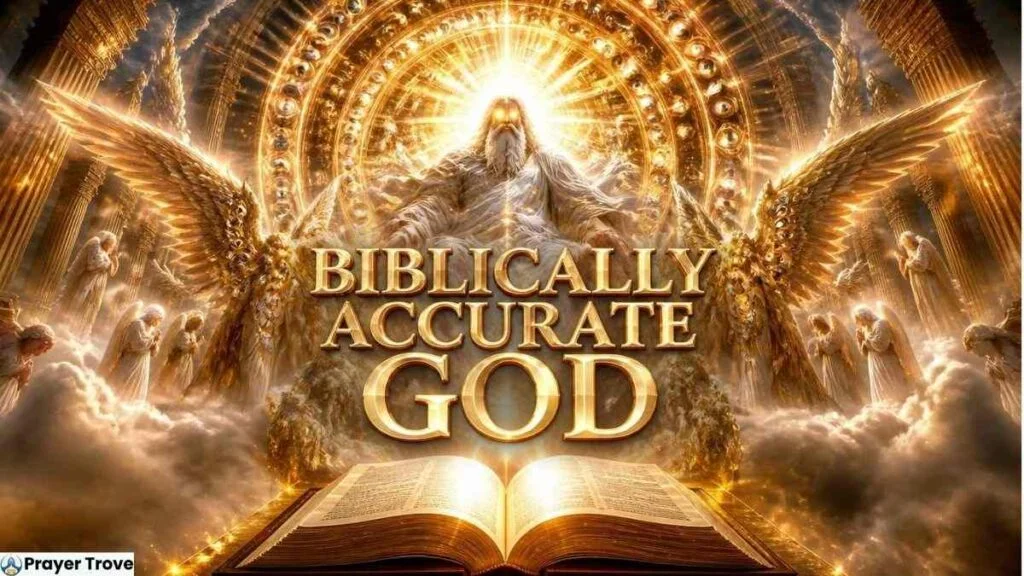
The phrase “biblically accurate” started online as a way to describe strange, detailed drawings of angels covered in eyes and wings. But the same question deserves a real answer when it comes to God himself. What does the Bible actually say about his form, his character, and his nature? Not internet art. Not childhood assumptions. The actual text.
This article walks through what Scripture says about God from beginning to end, so you can build a clear and accurate picture of who he is.
What Is a Biblically Accurate God?
A biblically accurate God is a picture of God built only from what the Bible says about him. It leaves out guesses, movies, and old traditions that never came from Scripture in the first place. Instead, it looks at his actions, his words, and how he describes himself across the whole Bible.
This matters because most people never really weigh their idea of God against the text. They inherit a picture from a childhood Sunday school class, a painting, or a story someone told them once. Some of that may be true. Some of it may not hold up at all. Reading Scripture directly is the only way to know for sure.
The Biblical Meaning of God
In the Bible, God is not one being among many. He is the one true God, the source of everything that exists. Genesis 1:1 opens with him already there, before the world takes shape: “In the beginning, God created the heavens and the earth.”
The Bible does not try to prove God exists. It assumes it from the very first verse and builds everything else on top of that. His name, revealed to Moses in Exodus 3:14 as “I AM WHO I AM,” points to something important. He does not depend on anything outside himself. He simply is.
God as Creator and Sustainer
God did not just start the world and step back. Scripture describes him as actively holding everything together. Colossians 1:17 says that in him “all things hold together,” meaning the universe keeps running because he keeps it running.
This shows up in smaller ways too. Psalm 104 describes God feeding animals, watering the earth, and setting boundaries for the seas. He is not a distant force who set things in motion once. He stays involved, day by day.
God’s Divine Nature in Scripture
The Bible describes God as spirit, not flesh and bone. John 4:24 states this directly: “God is spirit, and his worshipers must worship in the Spirit and in truth.” This means he does not have a body the way people do.
At the same time, the Bible gives him a personality. He speaks. He feels grief, anger, joy, and compassion. He is not a vague force or an abstract idea. He is a person, just not a physical one.
God’s Relationship With Humanity
Scripture presents God as someone who wants a real connection with people, not just obedience. He walked with Adam in the garden (Genesis 3:8). He spoke to Abraham as a friend (James 2:23). He calls his people into covenant relationships again and again.
This relationship shapes the entire Bible. God is not distant or indifferent. He shows up in the stories of ordinary people, correcting them, guiding them, and staying with them even after they fail.
How the Bible Describes God’s Appearance
People often want to know what God looks like. The honest answer is that the Bible rarely gives a plain, physical description. Instead, it uses powerful images that point toward something too big for normal words.
Biblical Descriptions of God’s Form
Since God is spirit, he does not have a fixed physical shape. Still, Scripture records moments when he appeared in ways people could see or sense. Moses saw a burning bush that kept burning without turning to ash (Exodus 3:2). Israel followed a pillar of fire and a pillar of cloud through the wilderness (Exodus 13:21).
These appearances were never meant to show his full form. Exodus 33:20 makes this clear when God tells Moses, “You cannot see my face, for no one may see me and live.” What people saw was always limited, a glimpse rather than the whole picture.
Symbolic and Literal Descriptions in Scripture
Some Bible passages use symbols to describe God. Others try to describe what people actually saw in a vision. The table below shows the difference.
| Description Type | Example | Bible Reference |
|---|---|---|
| Symbolic image | Fire and cloud representing God’s presence | Exodus 13:21-22 |
| Vision of a throne | A figure like glowing metal, surrounded by fire | Ezekiel 1:26-28 |
| Symbolic title | God as a “consuming fire” | Deuteronomy 4:24 |
| Literal encounter | Moses speaking with God “face to face” | Exodus 33:11 |
| Symbolic clothing | Hair like wool, clothing white as snow | Daniel 7:9 |
Even the “literal” encounters, like Moses speaking with God, still stop short of showing his full glory. The Bible protects the idea that no one fully sees God and survives it.
Why God Is Represented Through Symbols and Imagery
Human language has limits. Writers used fire, light, thrones, and storms because these images carried weight and mystery for ancient readers. Fire suggested power and holiness. Light suggested purity. A throne suggested authority.
These pictures were not meant to be taken as photographs. They were meant to leave readers with a feeling of awe, since God’s true glory goes beyond anything words can fully capture.
God Revealed in Biblical Visions
A few biblical writers describe direct visions of God’s glory. These passages are some of the most detailed descriptions in the entire Bible, and they shape how later writers talk about him.
Isaiah’s Vision of God’s Glory
In Isaiah 6:1-4, the prophet sees God seated on a high throne, with the train of his robe filling the temple. Flying creatures called seraphim call out, “Holy, holy, holy is the Lord Almighty,” and the doorposts shake at the sound of their voices.
Isaiah’s response is fear and awe. He calls himself ruined because he has seen the King, the Lord Almighty, with his own eyes. This vision shaped how later generations understood God’s holiness.
Ezekiel’s Vision of Divine Glory
Ezekiel’s vision, found in Ezekiel 1, is stranger and more detailed. He sees a storm, flashing fire, and living creatures with four faces each. Above them sits something like a throne, and on the throne, a figure that looked like a man, glowing like metal and surrounded by fire.
Ezekiel calls this “the appearance of the likeness of the glory of the Lord.” Even in his careful description, he keeps using words like “likeness” and “appearance,” showing that he knows he is describing something beyond normal sight.
John’s Vision of God’s Heavenly Glory
In Revelation 4, John describes a throne in heaven surrounded by a rainbow that looks like an emerald. The one seated on the throne looks like jasper and ruby. Thunder and lightning come from the throne, and creatures around it never stop praising him.
John’s vision echoes both Isaiah and Ezekiel, tying the Old and New Testaments together with similar imagery of thrones, light, and worship.
Understanding the Meaning of These Biblical Visions
These visions were never meant to give a full portrait of God. They were meant to communicate his majesty, holiness, and power in a way that ordinary description could not.
Each vision leaves the same impression: God is far greater than human categories can hold. The details differ, but the response is always the same, worship, awe, and a sense of being in the presence of something enormous.
The Core Attributes of the Biblically Accurate God
Beyond appearance, the Bible spends much more time describing God’s character. These qualities, called attributes, show up again and again across both Testaments.
| Attribute | Meaning | Key Bible Reference |
|---|---|---|
| Omnipotence | All-powerful | Jeremiah 32:17 |
| Omniscience | All-knowing | Psalm 147:5 |
| Omnipresence | Present everywhere | Psalm 139:7-10 |
| Holiness | Set apart, perfectly pure | Isaiah 6:3 |
| Righteousness | Always morally right | Deuteronomy 32:4 |
| Love | Caring and self-giving | 1 John 4:8 |
| Mercy | Kindness toward those who don’t earn it | Lamentations 3:22-23 |
| Sovereignty | Supreme control over all things | Isaiah 46:9-10 |
God’s Omnipotence and Sovereignty
Omnipotence means God has unlimited power. Jeremiah 32:17 puts it simply: “Nothing is too hard for you.” He spoke the universe into existence with words alone (Genesis 1:3).
Sovereignty is closely related. It means God has final authority over everything that happens. Isaiah 46:10 says he declares “the end from the beginning,” meaning nothing catches him off guard or slips outside his control.
God’s Omniscience and Wisdom
Omniscience means God knows everything, including things that have not happened yet. Psalm 147:5 says his understanding “has no limit.” He knows people’s thoughts before they speak them (Psalm 139:4).
His wisdom means he does not just know facts. He always knows the right way to act. Romans 11:33 marvels at the depth of his wisdom and knowledge, admitting that his ways are often too great to fully trace.
God’s Omnipresence and Eternal Nature
Omnipresence means God is not limited to one place. Psalm 139:7-10 asks where someone could go to escape his presence, and the answer is nowhere, not the highest heights nor the deepest depths.
His eternal nature means he has no beginning and no end. Psalm 90:2 says that before the mountains existed, “from everlasting to everlasting you are God.” Time itself does not limit him the way it limits everything he made.
God’s Holiness and Righteousness
Holiness means God is set apart from everything created and completely free from sin. Isaiah 6:3 repeats the word “holy” three times, a pattern that ancient Hebrew used to show the highest possible degree.
Righteousness flows out of that holiness. It means God always acts in a way that is right and fair. Deuteronomy 32:4 calls him “a faithful God who does no wrong, upright and just is he.”
God’s Love, Mercy, and Grace
First John 4:8 states plainly that “God is love.” This is not one trait among many. It describes his very nature. Everything he does connects back to this quality in some way.
Mercy is love shown to people who do not deserve it, and grace is a gift given freely rather than earned. Lamentations 3:22-23 says his mercies are “new every morning,” a picture of love that never runs dry.
Jesus Christ as the Revelation of God
If a reader wants to know what God is truly like, the Bible points directly at Jesus. Hebrews 1:3 calls him “the exact representation” of God’s being.
Jesus as the Image of the Invisible God
Colossians 1:15 calls Jesus “the image of the invisible God.” This means the God no one can fully see became visible and touchable through Jesus. People could hear his voice, watch him eat, and see him heal.
This is the central claim of the New Testament. God did not just send messages through Jesus. He showed up in him.
God’s Character Revealed Through Christ
The table below connects specific attributes of God to moments in Jesus’ life recorded in the Gospels.
| God’s Attribute | How Jesus Displayed It | Bible Reference |
|---|---|---|
| Power | Calming a violent storm with a word | Mark 4:39 |
| Knowledge | Knowing a stranger’s character before meeting him | John 1:47-48 |
| Compassion | Weeping at his friend’s death | John 11:35 |
| Holiness | Living a life free from sin | 1 Peter 2:22 |
| Mercy | Forgiving a woman condemned by others | John 8:10-11 |
Christ’s Divine Nature and Redemptive Work
Jesus’ life did more than show what God is like. It also accomplished something for humanity. Scripture points to several specific results of his death and resurrection:
- Paying the price for sin through his death on the cross (Romans 3:25-26)
- Rising from the dead, defeating death itself (1 Corinthians 15:20-22)
- Opening a way for people to be reconciled with God (2 Corinthians 5:18-19)
- Serving now as a mediator between God and people (1 Timothy 2:5)
The Triune Nature of God
The Bible describes God as one being who exists as three persons: Father, Son, and Holy Spirit. This is called the Trinity, and it sits at the center of Christian belief about who God is.
God the Father
The Father is often shown as the one who plans and directs the work of salvation. He sent his Son into the world (John 3:16) and adopts believers into his family (Ephesians 1:5).
Jesus regularly prayed to the Father and described their close relationship. In John 10:30, he says, “I and the Father are one.”
God the Son
The Son is Jesus Christ, fully God and fully human at the same time. Colossians 2:9 says that “in Christ all the fullness of the Deity lives in bodily form.”
He carried out the work of salvation directly, through his life, death, and resurrection. He now serves as the one who prays on behalf of believers (Hebrews 7:25).
God the Holy Spirit
The Holy Spirit is not a force or an energy. Scripture describes him as a person who teaches, comforts, and guides believers. John 16:13 says the Spirit guides people “into all the truth.”
He also convicts people of wrongdoing and gives them strength to live differently. Believers are described as being filled with, and guided by, his presence in their daily lives.
The Unity of the Father, Son, and Holy Spirit
The table below shows how Scripture presents all three persons together in the same moment, supporting the idea that they are distinct yet fully united as one God.
| Passage | What Happens |
|---|---|
| Matthew 3:16-17 | Father speaks from heaven, Spirit descends like a dove, Son is baptized |
| Matthew 28:19 | Jesus commands baptism in one name shared by Father, Son, and Spirit |
| 2 Corinthians 13:14 | Paul blesses believers using all three persons together |
| John 14:26 | Father sends the Spirit in the Son’s name |
God’s Character Across the Old and New Testaments
Some readers notice that God seems different in the Old Testament compared to the New Testament. The table below compares a few key traits across both sections of Scripture.
| Trait | Old Testament Example | New Testament Example |
|---|---|---|
| Love | Hosea 11:1-4 | John 3:16 |
| Justice | Deuteronomy 32:4 | Romans 2:6-11 |
| Mercy | Psalm 103:8-10 | Titus 3:4-5 |
| Holiness | Isaiah 6:3 | 1 Peter 1:15-16 |
God’s Justice and Judgment
The Old Testament describes God punishing sin, sometimes through direct action, like the flood in Genesis or judgment on nations that mistreated others. This can feel harsh without context.
The New Testament shows the same justice at work. Acts 5:1-11 records the sudden deaths of Ananias and Sapphira after they lied to God. Revelation describes future judgment in vivid terms as well. Justice against sin never disappears between the Testaments.
God’s Love and Mercy
The Old Testament is full of mercy too, though it gets less attention. Hosea 11:1-4 shows God caring for Israel like a parent teaching a child to walk. Psalm 103 describes him removing sin “as far as the east is from the west.”
The New Testament expresses the same love more directly through Jesus. John 3:16 says God gave his Son because he loved the world. The mercy shown throughout both Testaments comes from the same unchanging source.
The Consistency of God’s Character Throughout Scripture
Malachi 3:6 states that God does not change. Hebrews 13:8 says the same thing about Jesus specifically. What changes across Scripture is how much of God gets revealed at each stage of the story, not his actual character.
Think of it like a photo slowly coming into focus. Early parts of the Bible give a general shape. Later parts sharpen the details. The subject stays the same the entire time.
Common Misconceptions About the Biblically Accurate God
A lot of ideas about God come from places other than the Bible. The table below lists some common misconceptions and compares them with what Scripture actually says.
| Misconception | What Scripture Actually Says |
|---|---|
| God is a strict, angry judge waiting to punish | Exodus 34:6 describes him as compassionate, gracious, slow to anger |
| God is distant and uninvolved | Psalm 139:7-10 says he is present everywhere |
| God grants wishes if you ask correctly | James 4:8 focuses on closeness with God, not transactions |
| God’s rules exist to limit joy | Psalm 16:11 says fullness of joy is found in his presence |
Artistic Images Compared With Biblical Descriptions
Paintings often show God as an old man with a white beard sitting in the clouds. This image comes from art history, not Scripture. The Bible never gives God a fixed human appearance like this.
| Artistic Image | Biblical Description |
|---|---|
| Elderly man with a beard | Spirit without a fixed physical body (John 4:24) |
| Sitting calmly on a cloud | Surrounded by fire, storms, and blazing light (Ezekiel 1) |
| Gentle, passive expression | Voice that shakes doorposts (Isaiah 6:4) |
Internet Interpretations Compared With Scripture
Online trends about “biblically accurate angels” sometimes get applied to God himself, mixing up separate biblical concepts.
| Internet Trend | Biblical Reality |
|---|---|
| God pictured with wheels and many eyes | Those details describe angelic beings, not God (Ezekiel 1:15-18) |
| God shown as a strange creature | God is spirit, without a physical creature form (John 4:24) |
| God treated as a meme or joke figure | Scripture treats him with reverence and awe (Isaiah 6:1-5) |
Confusing God’s Appearance With Angelic Descriptions
Many of the strange details people associate with God actually belong to angels described in Ezekiel and Revelation. Wheels covered in eyes, four-faced creatures, and burning wings all describe angelic beings, not God himself.
Keeping this distinction clear matters. God’s own description centers on light, glory, and a throne, while these other details describe the beings who surround and serve him.
Biblically Accurate God and Biblically Accurate Angels
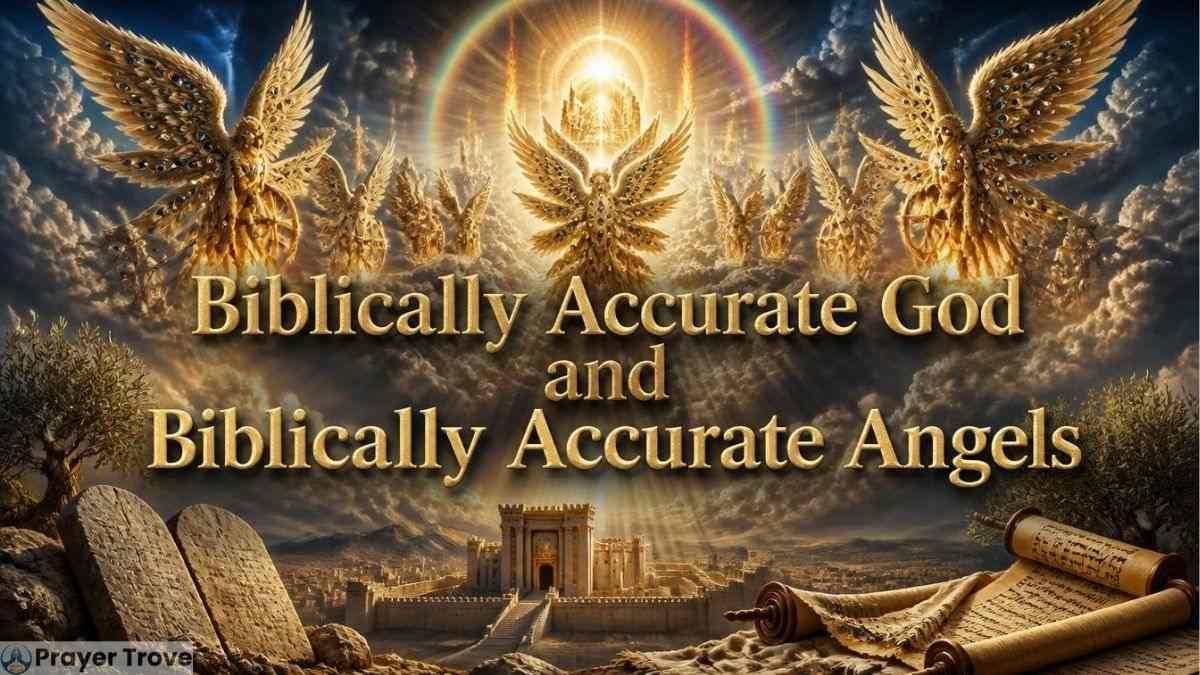
Since so much confusion online mixes God and angels, it helps to separate the two clearly.
The Difference Between God and Angels
God is the creator. Angels are created beings, made by him to serve and worship him. Colossians 1:16 lists thrones, powers, rulers, and authorities among the things God made, a category that includes angelic beings.
Angels appear throughout Scripture as messengers, protectors, and worshippers, but they are never described as equal to God or worthy of worship themselves. Revelation 22:8-9 shows an angel refusing worship and directing it back to God alone.
Differences in Nature, Authority, and Role
| Category | God | Angels |
|---|---|---|
| Nature | Uncreated, eternal | Created beings |
| Worship | Worthy of worship | Forbidden from receiving worship |
| Knowledge | All-knowing | Limited knowledge |
| Power | All-powerful | Powerful, but limited and given by God |
| Role | Ruler over all creation | Servants and messengers |
Key Bible Verses That Reveal God’s Nature
Certain verses come up again and again in discussions about God’s character. The tables below organize some of the clearest ones.
Old Testament Verses About God
| Verse | What It Reveals |
|---|---|
| Exodus 3:14 | God’s self-existence and eternal nature |
| Deuteronomy 32:4 | God’s perfect justice |
| Psalm 90:2 | God’s eternal existence |
| Isaiah 6:3 | God’s holiness |
| Jeremiah 32:17 | God’s unlimited power |
New Testament Verses About God
| Verse | What It Reveals |
|---|---|
| John 1:1 | Christ’s eternal existence alongside God |
| John 3:16 | God’s love for the world |
| Colossians 1:15 | Christ as the image of God |
| Hebrews 1:3 | Christ as the exact representation of God |
| 1 John 4:8 | God’s love as his defining nature |
Verses About God’s Character and Attributes
| Verse | Attribute Highlighted |
|---|---|
| Psalm 147:5 | Omniscience |
| Psalm 139:7-10 | Omnipresence |
| Malachi 3:6 | Unchanging nature |
| Lamentations 3:22-23 | Mercy |
| Isaiah 46:9-10 | Sovereignty |
The Biblical Picture of God
Put all these pieces together, and a clear picture starts to form. God is spirit, without a fixed physical body, yet he made himself known through fire, cloud, visions, and finally through Jesus Christ. He holds unlimited power and knowledge, yet he stays close to ordinary people. He is holy and just, yet endlessly merciful.
He exists as Father, Son, and Holy Spirit, three persons and one God, working together throughout history toward the same purpose. His character in the Old Testament matches his character in the New Testament exactly, even though the depth of what gets revealed grows over time.
Related Article : Biblically Accurate Lucifer
Conclusion
A biblically accurate picture of God comes only from Scripture itself, not from paintings, internet trends, or inherited assumptions. He is powerful, holy, and just, but also loving, merciful, and personal. Jesus Christ shows this most clearly, since he reveals God’s exact nature in human form. Reading the Bible directly remains the only reliable way to know who God truly is.
FAQs
What does “biblically accurate God” mean?
It means a picture of God’s nature built strictly from what the Bible says, rather than from art, movies, or personal assumptions.
What does God actually look like according to the Bible?
The Bible rarely gives a plain physical description. It uses images like fire, light, and thrones, since God is spirit and does not have a fixed body.
Is the God of the Old Testament different from the God of the New Testament?
No. Malachi 3:6 and Hebrews 13:8 both describe God as unchanging. What grows across Scripture is the depth of what gets revealed, not his actual character.
How is Jesus connected to a biblically accurate view of God?
Hebrews 1:3 calls Jesus the exact representation of God’s nature. His life, death, and resurrection show God’s character in a way words alone cannot.
Are biblically accurate angels the same as God?
No. Angels are created beings who serve and worship God. Strange details like wheels and multiple eyes describe angelic beings in Ezekiel’s vision, not God himself.