Choosing a name for your child is one of the most important decisions you will make. Parents want a name that sounds beautiful, carries meaning, and reflects their values. In recent years, the name Tristan has become increasingly popular among families around the world. Many parents are drawn to its strong sound and its connection to ancient legends.
One question that comes up often is about the Hebrew meaning of Tristan. People wonder if this name has roots in the Bible or the Hebrew language. This article gives you a complete and honest answer. It explains where the name comes from, what it really means, how it connects to spiritual ideas, and whether it is a good choice for a Christian family.
The simple truth is that Tristan is not a Hebrew name. It does not come from the Bible. However, the themes behind the name are deeply meaningful and align with many biblical values. By the end of this article, you will have all the information you need to decide if Tristan is the right name for your child.
What Does Tristan Mean in Hebrew?
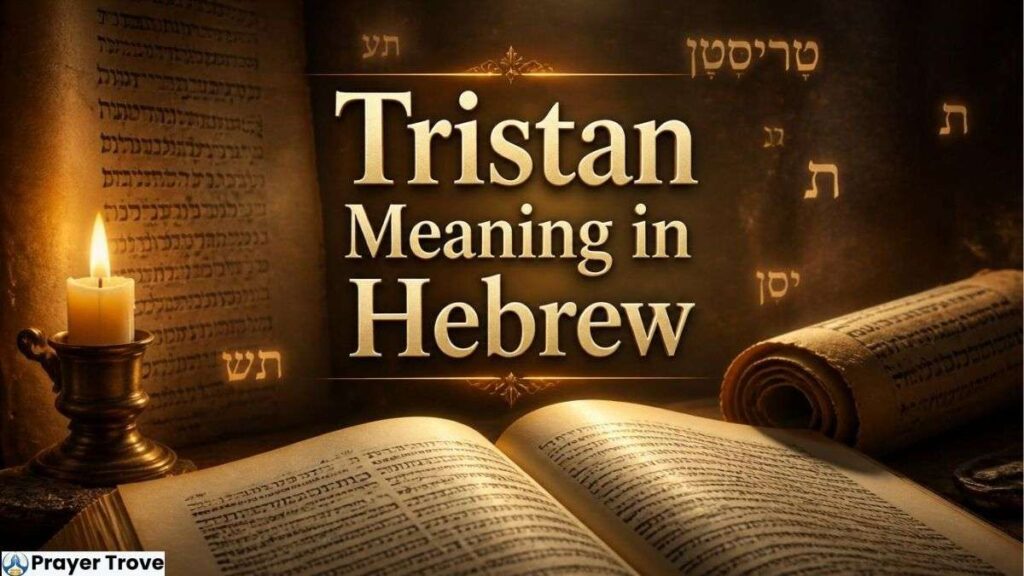
Tristan does not have a direct translation in Hebrew because it is not a Hebrew name. The name comes from Old Celtic and Latin roots.
When Hebrew speakers use the name, they write it as טריסטן. This is said like “Tree-stan.” It is just a way to write the English name using Hebrew letters. It does not change the meaning of the name.
Even though there is no Hebrew word for Tristan, some people look at Hebrew words that share similar ideas. These include:
- Atsab (עָצַב) – a Hebrew word for grief or sorrow.
- Chozek (חֹזֶק) – a Hebrew word for strength and inner power.
- Teshuah (תְּשׁוּעָה) – a Hebrew word for deliverance and salvation.
These words capture the feelings that people often connect with Tristan. The name speaks about sorrow, but it also speaks about the strength that can come from hard times. This is why many parents love the name even though it is not Hebrew.
Does Tristan Have Hebrew or Greek Roots?
| Language | Connection to Tristan | Explanation |
|---|---|---|
| Hebrew | No direct connection | Tristan is not a Hebrew name. It does not appear in the Old Testament or any ancient Hebrew writings. |
| Greek | No direct connection | Tristan is not a Greek name. It does not appear in the New Testament or any Greek historical records. |
| Celtic | The true origin | Tristan comes from the old Celtic name Drustan or Drystan, which meant “tumult” or “noise.” |
| Latin | A strong influence | The name was connected to the Latin word tristis, which means “sad” or “sorrowful.” |
| Old French | Helped spread the name | The name passed through French, where triste also means “sad.” |
The table provides a clear and quick answer. But understanding why people ask about Hebrew and Greek roots is helpful.
The Bible was written in Hebrew and Greek. The Old Testament was mostly written in Hebrew, with some parts in Aramaic. The New Testament was written in Greek. Because of this, many people believe that names from these languages have a special spiritual meaning. They think that if a name comes from Hebrew or Greek, it is more connected to God and the Bible.
Tristan does not come from either language. Its roots are in the Celtic languages of ancient Britain. The Celts lived in places like Wales, Scotland, and Cornwall. Their language was very different from Hebrew or Greek. The name developed in a culture that had no contact with the biblical world.
The Greek connection is also absent. While many names from the New Testament have Greek origins, Tristan does not. There is no Greek word that sounds like Tristan or means the same thing. The name developed far away from the Greek-speaking world and did not travel there until much later.
The Latin connection came later in history. When the name moved into French culture during the Middle Ages, people started to connect it to the Latin word tristis. This happened because the sounds were similar. Over time, the Latin meaning became part of the name’s identity, even though it was not its original meaning.
So the truth is clear. Tristan does not have Hebrew or Greek roots. It has Celtic roots with a strong Latin influence. But this does not make it a bad name or a less spiritual name. Many names we use today come from different languages. What matters is the meaning and the feelings the name brings to mind.
The Origin and Etymology of the Name Tristan
The name Tristan has a long and rich history. It started in ancient times and traveled through many cultures. Each culture added something new to the name, giving it layers of meaning that make it special today.
The Celtic Beginning
The story of Tristan begins with the Celtic people of ancient Britain. They lived in what is now Wales, Scotland, Cornwall, and parts of Ireland. In their language, they had a name that sounded like Drust or Drustanus. In Welsh, it became Drystan.
The Celtic root word drest meant “riot” or “tumult.” It also meant “noise” or “commotion.” So the original meaning of the name was something like “the noisy one” or “one who causes trouble.” This was not a negative thing in Celtic culture. Warriors were often loud and bold because they wanted to be noticed and feared by their enemies.
This name was common among the Picts, a group of people who lived in what is now Scotland. It was also used by the Welsh. The name was given to strong leaders and brave fighters. It stood for courage, power, and the ability to protect the tribe. If you had this name, people thought you were a warrior who could be trusted in battle.
The Latin and French Influence
The name changed when it crossed into French culture. This happened around the 12th century. French storytellers and poets heard the Celtic name and wrote it down in their own language. They spelled it as Tristan.
At the same time, something else was happening. In French, the word triste means “sad.” The Latin word tristis also means “sad” or “grieving.” Because the names sounded so similar, people started to connect them. They thought Tristan meant “sad” or “sorrowful.”
This change was not based on historical fact. It is what language experts call “folk etymology.” That means people made up a meaning because it sounded right to them, even though it was not the original meaning. Even though it was not based on history, the new meaning stuck. Over time, it became just as important as the old one.
The Legend of Tristan and Isolde
The name became truly famous because of a medieval love story called Tristan and Isolde. This story was told all over Europe. It was about a brave knight named Tristan who fell in love with a princess named Isolde. Their love was strong and true, but it brought them great sorrow.
In the story, Tristan is a hero. He fights dragons and protects his king. But he also suffers deeply because of his love for Isolde. He represents both courage and sadness. This story made the name Tristan known to millions of people across Europe. It also made the Latin meaning of “sorrow” very clear to everyone who heard the tale.
The legend of Tristan and Isolde is one of the great love stories of Western literature. It has been told and retold in poems, plays, and operas for centuries. The story helped cement the name in European culture and made it a favorite among nobility.
Two Meanings That Live Together
Today, the name Tristan carries both of its ancient meanings.
| Origin | Word | Meaning |
|---|---|---|
| Celtic | Drest / Drust | Tumult, noise, riot |
| Latin | Tristis | Sad, sorrowful |
Some people combine them and say Tristan means “noisy sorrow.” Others pick the one that means more to them. Both are correct. Both are part of the name’s long journey through history.
This is what makes Tristan so special. It is not just a simple name with one definition. It is a name with depth and layers. It speaks to strength and to emotion. It reminds us that people can be brave and still feel deeply. It is a name that tells a story, and that story gives it lasting meaning.
Is Tristan a Biblical Name?
The direct and honest answer is no. Tristan is not a biblical name. It does not appear anywhere in the Bible.
You will not find Tristan in the Old Testament. You will not find it in the New Testament. It is not in the Apocrypha, the collection of books that some churches include in their Bibles. The name is completely absent from Scripture in any language.
Why Is Tristan Not in the Bible?
The reason is straightforward. The Bible was written in a specific time and place. Most of it was written in Israel and the surrounding lands of the Middle East. The names in the Bible come from Hebrew, Aramaic, and Greek. These are the languages of that region and that time period.
Tristan comes from Europe. The Celtic people lived far away from Israel. They had their own language, their own culture, and their own naming traditions. The name Tristan developed centuries after the Bible was completed. It simply was not part of the biblical world.
The Bible contains names like David, Joshua, Samuel, and Daniel. These names have Hebrew roots. They have clear meanings in the Hebrew language. Tristan does not share these roots. It belongs to a different cultural and linguistic tradition.
Why People Think It Might Be Biblical
Sometimes people wonder if Tristan is biblical because it sounds similar to other names. They might think it is a variation of a biblical name or that it has been used in Christian communities for so long that it must be in Scripture. But this is not the case.
There is no biblical name that sounds like Tristan. There is no Hebrew name that means the same thing. The connection is simply not there. The belief that Tristan might be biblical is usually based on wishful thinking or on confusing it with other names.
Another reason people ask is that Tristan has been used by Christians for centuries. The name appears in medieval Christian literature and was used by knights and nobles who were devoted to the faith. Some people assume that if Christians have been using a name for so long, it must be biblical. But this is not how it works. Many Christian names are not biblical. They come from other languages and cultures that were adopted into Christian tradition over time.
Does This Mean Christians Cannot Use the Name?
No, not at all. Many Christian families use names that are not in the Bible. Think about the name Christian itself. It does not appear in the Bible as a personal name. The word is used to describe followers of Christ, but no one in the Bible is actually named Christian.
Other examples are Grace, Faith, Hope, and Trinity. These are common Christian names, but they are not the names of people in Scripture. They are concepts that come from the Bible, but they are not biblical names in the sense of being found in the genealogies or stories of the Bible.
What matters to most families is not whether a name appears in the Bible. What matters is whether the name’s meaning aligns with biblical values. Tristan speaks about sorrow, endurance, and hope. These are very biblical ideas. The Bible does not shy away from pain. It is honest about suffering. But it always points to hope and redemption.
So, while Tristan is not a biblical name, it can still be a deeply Christian name. It reflects the journey of faith that many believers walk. It reminds us that God works through hard times to bring about good things. This is the heart of the Christian message, and Tristan carries that message beautifully.
Tristan Meaning in Biblical and Spiritual Context
Even though Tristan is not in the Bible, its meaning fits well with biblical themes. The name tells a story of struggle and growth, hardship and hope. This is a story that the Bible tells over and over again.
The Bible is full of people who faced terrible hardships. They lost their families. They were thrown into prison. They were hunted by enemies. But they did not give up. They trusted God, and God brought them through their trials.
Tristan represents this same journey. The name says that sorrow is real. Pain is real. But sorrow and pain do not have the final word. Hope and strength can grow out of suffering. This is the heart of the Christian message and the story of redemption that runs through the entire Bible.
Biblical Symbolism Associated With Tristan
The name Tristan carries several important symbols that connect to the Bible and its teachings.
- Sorrow that builds character. The Bible teaches that suffering can make us stronger. Romans 5:3-4 says that suffering produces patience, and patience produces character, and character produces hope. Tristan reminds us that difficult times are not wasted. They shape who we become and make us more like Christ.
- Not giving up during hardship. The Bible is full of people who kept going even when everything was against them. Think about Job. He lost everything: his children, his money, and his health. But he did not curse God. He kept trusting. Tristan represents this kind of endurance and faithfulness.
- Pain that leads to purpose. Joseph was sold into slavery by his own brothers. He spent years in prison for a crime he did not commit. But God had a plan for his life. He rose to become a leader who saved his people from famine. Tristan shows that sorrow is not the end of the story. It is part of a bigger plan that God is working out.
- Hope that follows grief. Psalm 30:5 says that weeping may stay for the night, but joy comes in the morning. Tristan points to this promise. The sorrow does not last forever. Hope always comes, and joy follows the tears.
- Strength that comes from weakness. The Apostle Paul wrote that God’s power is made perfect when we are weak. When we cannot help ourselves, God steps in. Tristan shows that true strength does not come from ourselves. It comes from trusting God through hard times and allowing Him to work in our lives.
Spiritual Meaning of Tristan
The spiritual meaning of Tristan goes deeper than just a list of ideas. It speaks to the whole human experience of struggling, growing, and becoming who God created us to be.
On a spiritual level, Tristan represents emotional honesty. It does not pretend that life is always happy. It admits that we all face sorrow. This is healthy. It is better to be honest about our feelings than to pretend they do not exist. God can handle our honesty. The psalms are full of honest cries for help and expressions of pain.
Tristan also represents resilience. This means the ability to bounce back after being knocked down. When life knocks you down, you get back up. Tristan is a name for someone who does not stay down. They keep fighting, keep trusting, and keep moving forward.
Another spiritual quality of Tristan is compassion. People who have experienced sorrow often understand others better. They know what it feels like to hurt. This makes them kind and gentle with others who are suffering. Tristan suggests a person who cares deeply about others and shows them mercy.
Finally, Tristan represents faith under pressure. It is easy to trust God when life is easy. It is hard to trust God when life falls apart. Tristan points to the kind of faith that stays strong during the hardest times. This is the faith that the Bible celebrates and the kind of faith that inspires others.
Bible Verses That Reflect the Symbolic Meaning of Tristan
The Bible has many verses that speak to the themes of Tristan. These verses talk about sorrow, strength, hope, and endurance. Reading them helps you see why Tristan fits so well with a Christian worldview and why so many families are drawn to it.
Here is a table that shows some of these verses and how they connect to the name.
| Theme | Bible Verse | Connection to Tristan |
|---|---|---|
| Enduring through suffering | Romans 5:3-4 | Suffering builds patience, and patience builds character. Tristan shows this path from pain to strength. |
| Sorrow turns to joy | Psalm 30:5 | Weeping may last through the night, but joy comes in the morning. Tristan points to this hope. |
| Strength in weakness | 2 Corinthians 12:9 | God’s power is strongest when we are weak. Tristan shows strength that comes from trusting God. |
| Comfort for the grieving | Matthew 5:4 | Blessed are those who mourn, for they will be comforted. Tristan reflects this promise. |
| Trials make us mature | James 1:2-4 | Testing builds patience and makes us complete. Tristan stands for growth through hardship. |
| Hope in the middle of trouble | Romans 8:18 | Our current suffering is nothing compared to future glory. Tristan looks toward final hope. |
| God works everything for good | Romans 8:28 | God works for the good of those who love Him. Tristan shows trust in God’s plan. |
It is important to remember that Tristan is not named in these verses. The name does not appear in any of these passages. But the themes of the name are found all through them. The journey from sorrow to strength, from grief to hope, from weakness to power, is a major theme of the Bible.
When parents choose Tristan, they are often drawn to these very ideas. They want their child to be someone who endures, hopes, and grows through life’s challenges. They want their child to know that God is with them in the hard times and that He brings good out of suffering.
The Bible does not shy away from sorrow. It is honest about pain. But it always points to hope. Tristan does the same thing. It is a name that tells the truth about life while also pointing to God’s goodness and redemption.
Is Tristan a Good Christian or Catholic Name?
Yes, Tristan is widely considered a good name for Christian and Catholic families. It does not matter that it is not in the Bible. The meaning and the feelings behind the name are what matter most to families who choose it.
Why Christian Families Choose Tristan
There are several reasons why Christian parents pick the name Tristan for their children.
First, it matches biblical values. Even though the name is not in Scripture, it stands for things that are very biblical. Endurance, hope, faith under pressure, and compassion for others are all praised in the Bible. Tristan represents these qualities in a powerful and memorable way.
Second, Christians have used this name for a very long time. The name has been around since the Middle Ages. During that time, it was used by knights and nobles who were devoted to the Christian faith. Many of these people saw the name as a good one for their children and passed it down through generations.
Third, the name has positive spiritual meaning. It does not glorify sin or evil. It does not come from a pagan god or a false religion. It simply speaks to the human experience of struggle and growth. This makes it safe and meaningful for Christian families who want a name with depth.
Fourth, the name is accepted by many different churches. You will find Tristan in Catholic families, Protestant families, and Orthodox families. It is a name that crosses denominational lines. There is no church that forbids it or teaches that it is inappropriate.
Fifth, the name is familiar but not overused. Many parents want a name that people can say and spell easily. They also want a name that is not so common that their child will be one of several with the same name in their class. Tristan strikes this balance well.
The Catholic Perspective
In the Catholic Church, there is a strong tradition of naming children after saints. Many Catholic parents want their child to have a patron saint to pray for them and guide them.
Tristan does not have a saint. There is no Saint Tristan on the official list of Catholic saints. But this does not mean the name is not allowed or is bad. The Church does not require that names come from the Bible or from a saint. It only says that names should not go against Christian teaching. Tristan does not do this.
Many Catholic families still choose Tristan. They like its meaning and its history. They may choose a second name that is a saint’s name, such as Tristan Michael or Tristan Joseph. Or they may simply dedicate their child to Mary or another saint. The absence of a Saint Tristan is not a problem for most Catholic parents.
The Protestant Perspective
Protestant families also embrace the name. Protestant traditions put a strong focus on the Bible. But they also value names that have good meanings and that reflect Christian values.
Protestant parents often look for names that remind them of faith. Tristan does this because it speaks to endurance and hope. It makes them think of the stories of Job, Joseph, and David. These are very biblical figures who faced hardship and trusted God.
Protestants do not have the same tradition of patron saints. So the fact that there is no Saint Tristan does not matter to them. They look at the meaning of the name and its connection to biblical ideas. They are also free to choose names from any language or culture, as long as the meaning is good.
What Pastors and Leaders Say
Many Christian leaders have spoken about choosing names for children. They often say the same thing. The most important thing is the meaning you give to the name. You can pray over your child. You can bless them. You can teach them about their name and what it represents. This is what makes a name Christian, not just the language it comes from.
A pastor might say that Tristan is a good name because it reminds us that God is with us through all things. The name does not promise a life without problems. But it does promise that we can find strength and hope in God. This is a very Christian message and a beautiful thing to teach a child.
Practical Things to Think About
If you are thinking about naming your child Tristan, here are a few things to consider.
Think about how it sounds with your last name. Say it out loud. Make sure you like the way it flows and that it is easy to say.
Think about how you will pronounce the name. Most people say “Tris-tan.” Some say “Tris-tin.” Both are common. Pick the one you like best.
Think about nicknames. Tristan can be shortened to Tris, Tan, or Tee. See if you like these or if there are other natural shortenings.
Think about the spelling. Tristan is the most common spelling. But there are others, including Tristen, Trystan, and Tristram. Each one has its own feel and history. Choose the one that you like best.
Overall, Tristan is a strong, beautiful, and meaningful name. It fits well in a Christian home and carries a message of hope and strength that will serve your child well for their whole life.
Related Post : Tristan Meaning in Bible
Conclusion
The name Tristan is not Hebrew. It does not come from the Bible. It started with the Celtic people of ancient Britain, where it meant “tumult” or “noise.” Later, it became linked to the Latin word for “sorrow.” These two meanings live together today, giving the name depth and richness.
But the name is more than just its history. It stands for something powerful. It stands for the journey from sorrow to strength. It stands for hope that rises out of grief. It stands for faith that endures through the hardest times and comes out stronger.
These ideas are very biblical. The Bible is full of stories about people who suffered and found hope. Job lost everything but kept his faith. Joseph was sold into slavery but became a leader. David was hunted by a king but became a king himself. Their stories match the themes of Tristan perfectly.
For Christian families, Tristan is a meaningful choice. It does not pretend that life is easy. It is honest about pain. But it always points to redemption and growth. It is a name that says, “Sorrow is not the final word. God brings good out of all things.”
Whether you choose Tristan for its warrior history, its emotional depth, its spiritual meaning, or just because it sounds beautiful, you are giving your child a name with a rich story. A name that will remind them that strength can come from struggle. A name that points to hope. A name that carries the message of faith through hardship and into redemption.
FAQs
What is the biblical meaning of the name Tristan?
Tristan does not have a biblical meaning because it is not a biblical name. It is not found in the Bible. The name comes from Celtic and Latin roots. However, the themes of Tristan, such as sorrow, endurance, and hope, are found throughout Scripture and align with many biblical teachings.
Does Tristan appear in any Bible verses?
No, Tristan does not appear in any Bible verses. It is not mentioned in the Old Testament, the New Testament, or any other biblical books. The name developed centuries after the Bible was written and in a completely different part of the world.
What does Tristan mean in biblical Hebrew?
Tristan has no meaning in biblical Hebrew because it is not a Hebrew name. When Hebrew speakers write the name, they use the Hebrew spelling טריסטן (Tree-stan). This is simply a way to represent the sounds of the name in Hebrew letters, not a translation with a Hebrew meaning.
Is Tristan a good Christian name for a baby?
Yes, many Christian families consider Tristan a good name for a baby. It is not in the Bible, but it reflects Christian values like faith, endurance, and hope through hard times. It has a positive meaning, a rich history, and is accepted by many Christian traditions.
What is the spiritual significance of naming a child Tristan?
The spiritual significance of Tristan is found in its themes of sorrow, endurance, and transformation. The name represents moving from hardship to hope. This matches the biblical teaching that God works through suffering to bring about good things and that our trials produce character and hope.
Are there any saints or biblical figures named Tristan?
No, there are no saints or biblical figures named Tristan. The name is not in the Bible or on the official list of Catholic saints. However, Christians have used the name for many centuries, and it is widely accepted as a meaningful Christian name.