
If you’ve ever wanted to pray the Lord’s Prayer in Spanish, you’re not alone. Millions of Spanish speakers around the world recite this prayer every day. In Spanish, it’s called the Padre Nuestro — which simply means “Our Father.”
This guide gives you the complete Spanish text, an English translation, pronunciation help, the meaning of each line, and the differences between Catholic and Protestant versions. Whether you’re learning Spanish, attending a Spanish‑speaking church, or simply want to pray in another language, this guide will help you pray the Padre Nuestro with understanding.
The Complete Lord’s Prayer in Spanish — Padre Nuestro
Here is the full Lord’s Prayer in Spanish. This is the version most commonly used in Catholic and many Protestant churches across the Spanish‑speaking world.
Padre nuestro, que estás en el cielo,
santificado sea tu Nombre;
venga a nosotros tu reino;
hágase tu voluntad en la tierra como en el cielo.
Danos hoy nuestro pan de cada día;
perdona nuestras ofensas,
como también nosotros perdonamos a los que nos ofenden;
no nos dejes caer en la tentación,
y líbranos del mal.
Amén.
This prayer comes directly from Matthew 6:9–13, where Jesus taught His disciples how to pray.
Lord’s Prayer in Spanish With English Translation
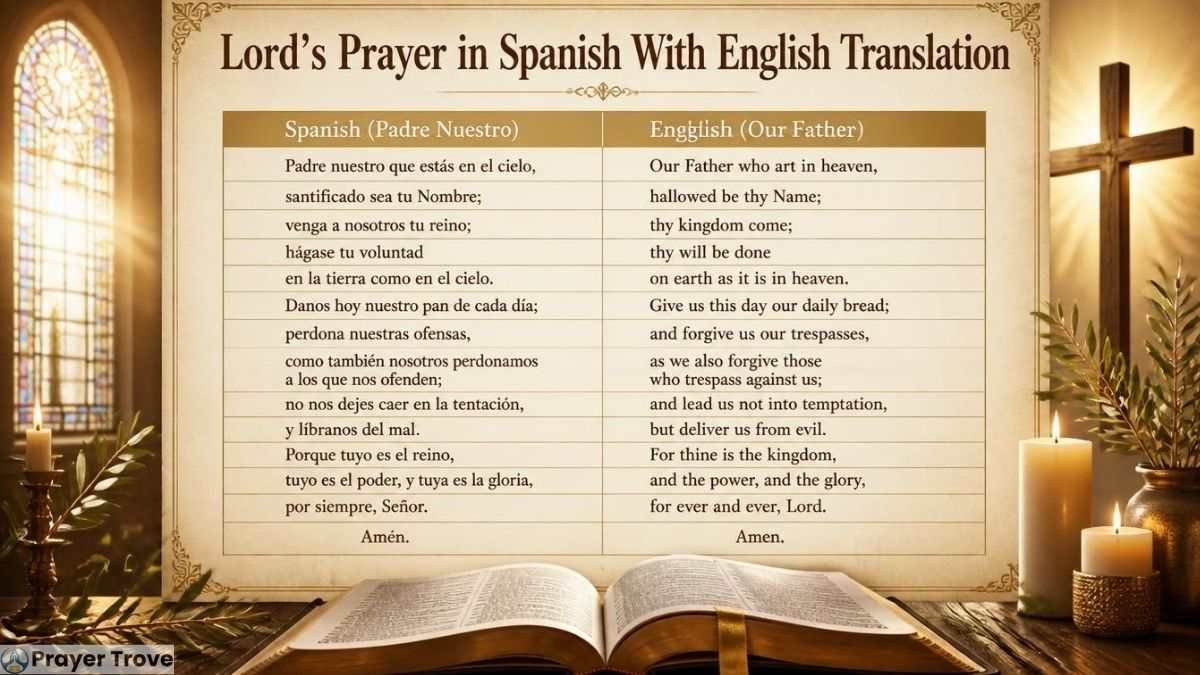
Below is the Padre Nuestro side by side with the English version. This makes it easy to see what each Spanish line means.
| Spanish (Padre Nuestro) | English (Our Father) |
|---|---|
| Padre nuestro, que estás en el cielo, | Our Father, who art in heaven, |
| santificado sea tu Nombre; | hallowed be thy name; |
| venga a nosotros tu reino; | thy kingdom come; |
| hágase tu voluntad en la tierra como en el cielo. | thy will be done on earth as it is in heaven. |
| Danos hoy nuestro pan de cada día; | Give us this day our daily bread; |
| perdona nuestras ofensas, | and forgive us our trespasses, |
| como también nosotros perdonamos a los que nos ofenden; | as we forgive those who trespass against us; |
| no nos dejes caer en la tentación, | and lead us not into temptation, |
| y líbranos del mal. | but deliver us from evil. |
| Amén. | Amen. |
How to Pronounce the Lord’s Prayer in Spanish
Spanish pronunciation is straightforward because words are pronounced exactly as they’re written. Here’s how to say each key phrase:
| Spanish Phrase | Pronunciation Guide |
|---|---|
| Padre nuestro | PAH‑dray NWEHS‑troh |
| que estás en el cielo | keh ehs‑TAHS ehn ehl SYEH‑loh |
| santificado sea tu nombre | sahn‑tee‑fee‑KAH‑doh SAY‑ah too NOHM‑breh |
| venga a nosotros tu reino | VEHN‑gah ah noh‑SOH‑trohs too RAY‑noh |
| hágase tu voluntad | AH‑gah‑say too boh‑loon‑TAHD |
| en la tierra como en el cielo | ehn lah TYEH‑rah KOH‑moh ehn ehl SYEH‑loh |
| danos hoy nuestro pan de cada día | DAH‑nohs oy NWEHS‑troh pahn deh KAH‑dah DEE‑ah |
| perdona nuestras ofensas | pehr‑DOH‑nah NWEHS‑trahs oh‑FEHN‑sahs |
| como también nosotros perdonamos | KOH‑moh tahm‑BYEHN noh‑SOH‑trohs pehr‑doh‑NAH‑mohs |
| a los que nos ofenden | ah lohs keh nohs oh‑FEHN‑dehn |
| no nos dejes caer en la tentación | noh nohs DEH‑hehs kah‑EHR ehn lah tehn‑tah‑SYOHN |
| y líbranos del mal | ee LEE‑brah‑nohs dehl mahl |
| amén | ah‑MEHN |
Pronunciation tips:
- The “r” in Spanish is rolled slightly, especially at the beginning of words.
- The “ll” sounds like a soft “y” in most Spanish‑speaking regions.
- The “h” is always silent — so “hágase” sounds like “AH‑gah‑say.”
- The “j” sounds like a hard “h” — so “dejes” sounds like “DEH‑hehs.”
What Does “Padre Nuestro” Mean?
“Padre Nuestro” translates directly to “Our Father.”
- Padre means “father.”
- Nuestro means “our.”
In Spanish, the prayer is almost always called by these two words. You might also hear it called “El Padrenuestro” — which is simply the two words combined into one.
The name matters because it captures the very first word of the prayer. Jesus taught His followers to address God as “Our Father” — not as a distant ruler, but as a loving parent. This was a radical way to pray in Jesus’s time, and it remains the heart of the prayer today.
Line-by-Line Meaning of the Lord’s Prayer in Spanish
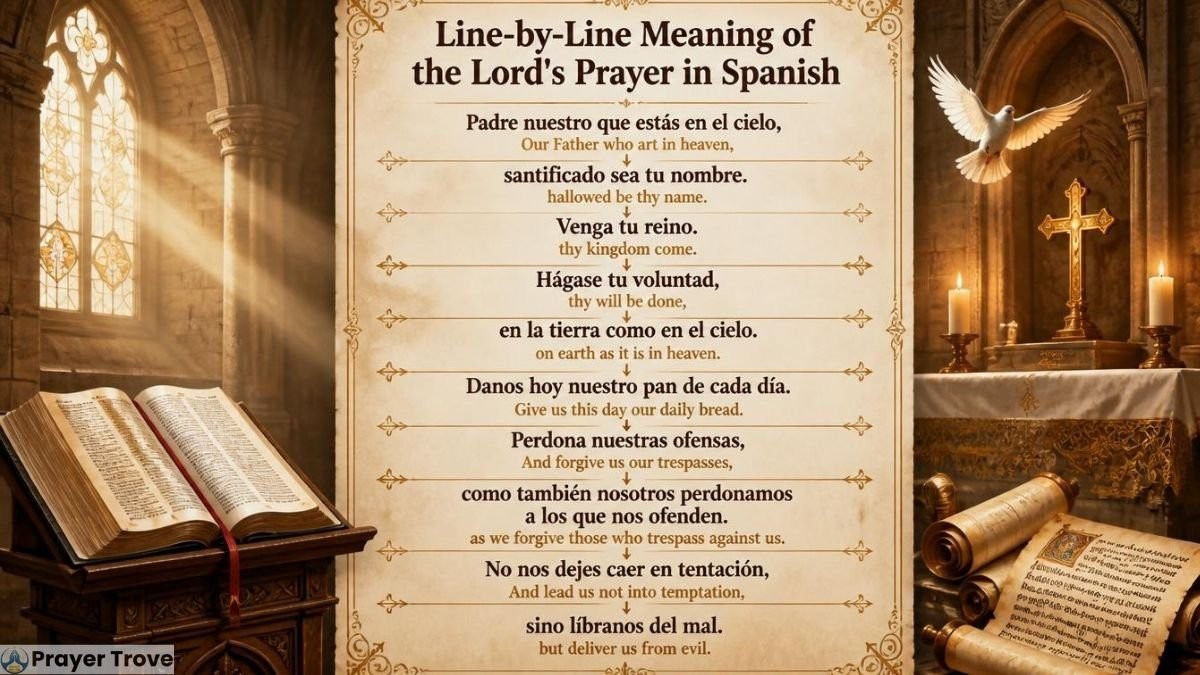
Each line of the Padre Nuestro carries deep meaning. Here’s what each petition means.
Padre Nuestro que estás en el cielo
“Our Father, who art in heaven.”
This opening line establishes who we are praying to. God is our Father — a relationship of love and care. He is also in heaven — meaning He is above us, holy, and worthy of our respect. The prayer begins by acknowledging both God’s closeness (Father) and His greatness (in heaven).
Santificado sea tu nombre
“Hallowed be thy name.”
Santificado means “made holy” or “treated as sacred.” This is not a statement — it’s a request. We are asking that God’s name would be honored and respected. In our words, in our actions, and in the world around us, may God’s name be treated as holy.
Venga a nosotros tu reino
“Thy kingdom come.”
This is a prayer for God’s reign to be fully realized. In Spanish, venga means “come.” We are asking God to bring His kingdom — His rule of justice, peace, and love — into our world. This petition looks forward to the day when God’s will is done completely everywhere.
Hágase tu voluntad en la tierra como en el cielo
“Thy will be done on earth as it is in heaven.”
Hágase means “let it be done” or “may it be done.” In heaven, God’s will is done perfectly. On earth, it often is not. This line asks that what is true in heaven would become true here on earth. It is a prayer of surrender — asking God to shape our lives according to His purposes, not our own.
Danos hoy nuestro pan de cada día
“Give us this day our daily bread.”
Danos means “give us.” This is a prayer for daily provision. The Spanish phrase pan de cada día means “bread of each day.” It acknowledges that we depend on God for our most basic needs — food, shelter, and everything we require to live. Jesus doesn’t separate spiritual life from physical needs. Both matter to God.
Perdona nuestras ofensas, como también nosotros perdonamos
“Forgive us our trespasses, as we forgive those who trespass against us.”
Perdona means “forgive.” Ofensas means “offenses” or “trespasses.” This is the most challenging line in the prayer. It links God’s forgiveness to our willingness to forgive others. The word “como” (as) creates a direct connection: we ask God to forgive us in the same way we forgive others. It’s not that we earn forgiveness — but Jesus makes clear that forgiveness and unforgiveness cannot coexist in the same heart.
No nos dejes caer en la tentación
“Lead us not into temptation.”
No nos dejes caer means “do not let us fall.” This is a request for protection. We are asking God to keep us from situations where we might be tempted beyond what we can bear. The Bible says God does not tempt anyone (James 1:13), so this is a prayer for strength and deliverance from testing.
Líbranos del mal
“Deliver us from evil.”
Líbranos means “free us” or “rescue us.” This final petition asks for protection from evil — both the evil that exists in the world and the evil one (the devil). It is a prayer for safety, for God’s protection over our lives, and for deliverance from anything that would harm us spiritually or physically.
Where Is the Lord’s Prayer Found in the Bible?
The Lord’s Prayer appears in two places in the Bible:
- Matthew 6:9–13 — This is the longer version, given during the Sermon on the Mount. Jesus teaches His disciples how to pray as part of a larger lesson about prayer.
- Luke 11:2–4 — This is a shorter version. A disciple asks Jesus, “Lord, teach us to pray,” and Jesus responds with this prayer.
The version in Matthew is the one most Christians use today. In Spanish Bibles, you can find it in Mateo 6:9–13.
Here is the text from the Reina‑Valera 1995 Spanish Bible:
“Vosotros, pues, oraréis así: ‘Padre nuestro que estás en los cielos, santificado sea tu nombre. Venga tu Reino. Hágase tu voluntad, como en el cielo, así también en la tierra. El pan nuestro de cada día, dánoslo hoy. Perdónanos nuestras deudas, como también nosotros perdonamos a nuestros deudores. No nos metas en tentación, sino líbranos del mal.'”
The Biblical Meaning and Origin of the Lord’s Prayer
The Lord’s Prayer comes from Jesus Himself. When His disciples asked Him how to pray, He gave them this model.
But the prayer didn’t come out of nowhere. It is rooted in Jewish prayer traditions. Many of its phrases echo the Old Testament — especially the Psalms and prayers of the prophets. For example:
- “Hallowed be your name” reflects the Jewish practice of sanctifying God’s name.
- “Your kingdom come” reflects the Jewish hope for God’s reign on earth.
- “Deliver us from evil” echoes prayers for protection found throughout the Psalms.
What made Jesus’s prayer unique was its intimacy. Calling God “Father” in this personal way was uncommon in Jewish prayer at the time. Jesus made this closeness the starting point of all prayer.
The prayer also appears in the context of Jesus teaching about how not to pray. Just before giving this prayer, Jesus warned against:
- Praying to be seen by others (performative prayer)
- Using meaningless repetition (vain repetition)
The Lord’s Prayer is the antidote to both. It is brief, structured, and directed to God — not to impress other people.
Lord’s Prayer in Luke vs. Matthew
The Lord’s Prayer appears in both Matthew and Luke, but the two versions are not identical. Here’s how they compare:
| Element | Matthew 6:9–13 | Luke 11:2–4 |
|---|---|---|
| Address | “Our Father in heaven” | “Father” |
| Hallowing | “Hallowed be your name” | “Hallowed be your name” |
| Kingdom | “Your kingdom come” | “Your kingdom come” |
| Will | “Your will be done on earth as in heaven” | (omitted) |
| Bread | “Give us today our daily bread” | “Give us each day our daily bread” |
| Forgiveness | “as we forgive our debtors” | “for we also forgive everyone who sins against us” |
| Temptation | “lead us not into temptation, deliver from evil” | “lead us not into temptation” |
Why are they different? Jesus likely taught this prayer on more than one occasion. Matthew records it as part of the Sermon on the Mount — a longer teaching session. Luke records it as a direct response to a disciple’s question. The slight variations reflect natural differences in how the same teaching was delivered and remembered in different communities.
Both versions are authentic. Neither is “wrong.” They simply reflect different contexts and purposes.
Why Do Christians Pray the Lord’s Prayer?
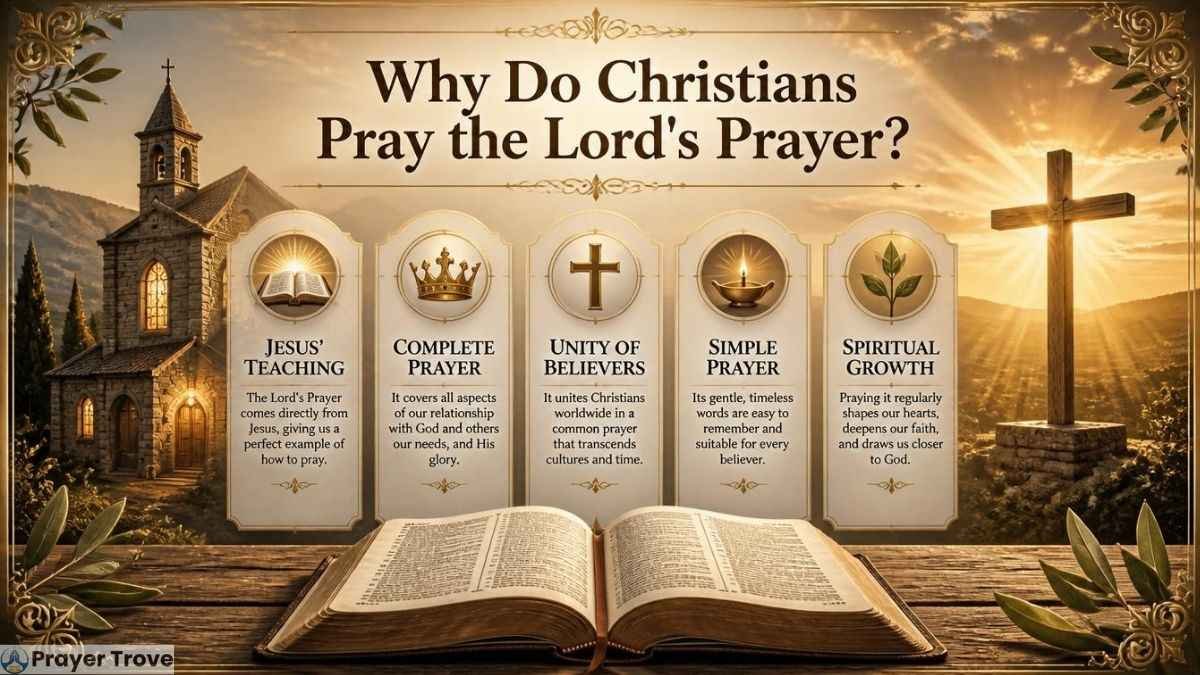
Christians pray the Lord’s Prayer for many reasons:
- It was taught by Jesus. This is the prayer Jesus Himself gave as a model. Praying it connects believers directly to His teaching.
- It covers everything. The prayer includes worship, surrender, dependence, forgiveness, and protection. Every human need is somewhere in these words.
- It unites believers. Millions of Christians around the world pray this same prayer every day, in hundreds of languages. It is a shared experience across denominations and cultures.
- It keeps prayer simple. When we don’t know what to pray, the Lord’s Prayer gives us words. It reminds us what matters most.
- It shapes our hearts. Praying these words regularly forms us — teaching us to honor God, trust Him for our needs, forgive others, and seek His protection.
Catholic and Protestant Versions of the Lord’s Prayer in Spanish
Catholic and Protestant versions of the Padre Nuestro are almost identical — but there are small differences, especially at the end.
| Line | Catholic Version | Protestant Version |
|---|---|---|
| Address | Padre nuestro, que estás en el cielo | Padre nuestro, que estás en los cielos |
| Forgiveness | perdona nuestras ofensas | perdona nuestras deudas (debts) |
| Closing | y líbranos del mal. Amén. | y líbranos del mal. Porque tuyo es el reino, el poder y la gloria, por todos los siglos. Amén. |
Why the difference?
The main difference is the final line — the doxology (“For thine is the kingdom, the power, and the glory forever”). Catholic liturgies typically omit this line because it does not appear in the oldest Greek manuscripts of Matthew 6.
Protestant versions often include it because their translation tradition (especially the King James Version) was based on later manuscripts that included it.
The Catholic approach: In the Mass, Catholics pray the Padre Nuestro without the doxology. Then the priest adds a prayer called the embolism, and the congregation responds with the doxology separately: “Porque tuyo es el reino, el poder y la gloria, por los siglos de los siglos.”
Neither version is “more correct.” They reflect different manuscript traditions, both ancient and respected.
How to Memorize the Lord’s Prayer in Spanish
Memorizing the Padre Nuestro is easier than you might think. Here are some practical tips:
- Start with the first line. Learn “Padre nuestro, que estás en el cielo” until you can say it without looking.
- Add one line at a time. Each day, add the next line. Repeat the whole prayer from the beginning each time.
- Say it out loud. Speaking the words helps your mouth and ears learn the rhythm.
- Use the English translation. Knowing what each line means helps you remember the Spanish words.
- Pray it daily. The best way to memorize any prayer is to pray it regularly. Try saying the Padre Nuestro each morning or evening.
- Write it down. Copy the prayer by hand. Writing engages a different part of your brain and helps with memorization.
- Listen to it. Find a recording of the Padre Nuestro and listen to it. Hearing the pronunciation helps lock it in.
- Practice with someone. If you know a Spanish speaker, ask them to pray it with you.
With consistent practice, most people can memorize the Padre Nuestro in a week or two.
Related post : Glory Be Prayer in Spanish
Conclusion
The Lord’s Prayer in Spanish — the Padre Nuestro — is more than just words in another language. It is the same prayer Jesus taught His disciples, prayed by millions of Spanish speakers across the globe every single day.
Whether you are learning Spanish, visiting a Spanish‑speaking church, or simply want to connect with the global body of Christ, praying the Padre Nuestro is a meaningful way to do it.
Start with one line. Say it slowly. Let each word sink in. And remember — the Father who taught this prayer understands every language. He hears you in Spanish just as clearly as in English.
Padre nuestro, que estás en el cielo, santificado sea tu Nombre…
Frequently Asked Questions
What is the Lord’s Prayer in Spanish?
The Lord’s Prayer in Spanish is called the Padre Nuestro. The full text is: “Padre nuestro, que estás en el cielo, santificado sea tu Nombre; venga a nosotros tu reino; hágase tu voluntad en la tierra como en el cielo. Danos hoy nuestro pan de cada día; perdona nuestras ofensas, como también nosotros perdonamos a los que nos ofenden; no nos dejes caer en la tentación, y líbranos del mal. Amén.”
How do you say “Our Father” in Spanish?
“Our Father” in Spanish is “Padre Nuestro.” Padre means “father,” and nuestro means “our.”
What is the difference between the Catholic and Protestant Lord’s Prayer in Spanish?
The main difference is the ending. Catholic versions typically end with “y líbranos del mal. Amén.” Protestant versions often include the doxology: “Porque tuyo es el reino, el poder y la gloria, por todos los siglos. Amén.”
Where is the Lord’s Prayer in the Spanish Bible?
The Lord’s Prayer is found in Mateo 6:9–13 (Matthew 6:9–13) and in Lucas 11:2–4 (Luke 11:2–4).
Why do some Spanish versions say “ofensas” and others say “deudas”?
Ofensas means “offenses” or “trespasses.” Deudas means “debts.” Both translate the same Greek word (opheilema), which means “what is owed.” Catholic versions tend to use ofensas, while Protestant versions often use deudas.
How do you pronounce “Padre Nuestro”?
Padre Nuestro is pronounced PAH‑dray NWEHS‑troh. The “a” in Padre sounds like the “a” in “father.” The “ue” in Nuestro sounds like the “ue” in “blue.”










:+Full+Text,+Meaning+&+Guide)
:+Full+Text,+Meaning+&+Guide&description=&image=https://prayertrove.com/wp-content/uploads/2026/06/lords-prayer-in-spanish-el-padre-nuestro-full-text-meaning-and-guide-1024x576.jpg)