The name Charlotte means “free woman.” It holds spiritual meaning for many Christian families, even though it isn’t found in the Bible. This article looks at the name’s origins, biblical links, and spiritual meaning. It aims to help parents grasp its significance for their daughter.
Charlotte has become increasingly popular among Christian families in recent years. Its appeal lies not in biblical occurrence but in its powerful meaning and the spiritual values it represents. The name speaks of liberation, strength, and grace—qualities that resonate deeply with the Christian faith.
This guide looks at the language roots of Charlotte, its history, and its links to biblical themes. It answers common questions about the name and gives helpful tips for parents thinking about it for their child.
Charlotte and Its Biblical Connection
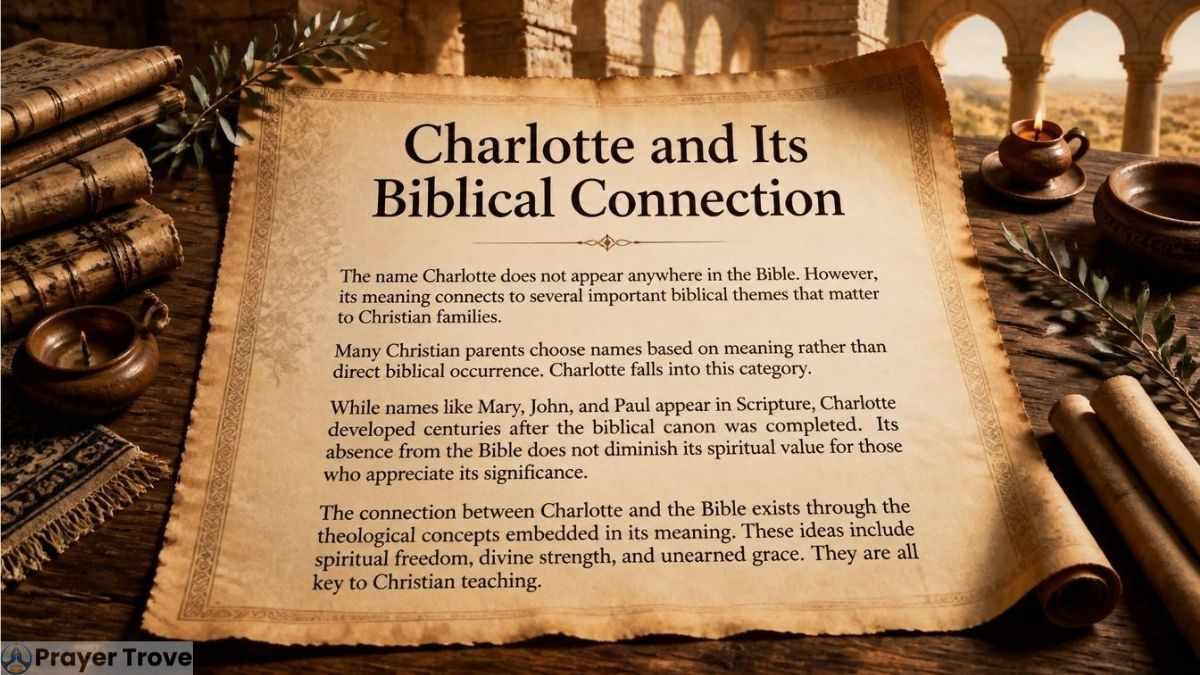
The name Charlotte does not appear anywhere in the Bible. However, its meaning connects to several important biblical themes that matter to Christian families.
Many Christian parents choose names based on meaning rather than direct biblical occurrence. Charlotte falls into this category. While names like Mary, John, and Paul appear in Scripture, Charlotte developed centuries after the biblical canon was completed. Its absence from the Bible does not diminish its spiritual value for those who appreciate its significance.
The connection between Charlotte and the Bible exists through the theological concepts embedded in its meaning. These ideas include spiritual freedom, divine strength, and unearned grace. They are all key to Christian teaching.
Why Charlotte Is Not a Biblical Name
Charlotte does not appear in the Hebrew, Aramaic, or Greek manuscripts of the Bible. The name emerged in Europe during the medieval period, long after the biblical texts were written.
The Bible contains names from ancient Near Eastern cultures. Charlotte, however, has Germanic and French origins. It developed from the Old German word Karl, which meant “free man.” This word entered French as Charles and later produced the feminine form Charlotte.
Many commonly used Christian names today do not appear in Scripture. Names like Grace, Faith, Hope, and Victoria are also absent from the Bible. Their absence does not prevent them from carrying spiritual meaning for believers.
Biblical Significance of Charlotte
Though not found in Scripture, Charlotte carries significant biblical meaning through its core definition. The name means “free woman,” which directly relates to the New Testament theme of spiritual liberation.
The Apostle Paul frequently wrote about freedom in Christ. In Galatians 5:1, he states that Christ has set believers free. This freedom represents release from sin, guilt, and spiritual bondage. The name Charlotte can serve as a reminder of this truth.
Additionally, the name connects to biblical ideals of strength and dignity. Proverbs 31:25 describes a virtuous woman as “clothed with strength and dignity.” Charlotte, with its roots in strength and nobility, reflects this scriptural portrait.
Charlotte Meaning in the Bible
| Aspect | Literal Meaning | Biblical Connection |
|---|---|---|
| Basic Definition | Free woman, petite | Represents spiritual freedom in Christ (Galatians 5:1) |
| Strength | Vigorous, strong (from Karl) | Connects to Deborah’s courage and Esther’s faith |
| Grace | Royal, noble | Reflects unearned favor (Ephesians 2:8-9) |
| Humility | Diminutive suffix “-ette” | Points to servant leadership (Matthew 23:11) |
| Character | Dignified, purposeful | Aligns with Proverbs 31 woman |
Literal Meaning
Literally, Charlotte means “free woman” or “petite.” This definition comes from its development as a feminine form of Charles, which derives from the Germanic Karl meaning “free man.”
In historical contexts, a “free woman” was someone with personal rights and autonomy. She was not bound to a master or in servitude. This literal meaning has social and historical significance that predates any religious interpretation.
For Christian families, this literal definition opens the door to spiritual applications. Freedom in the ancient world helps us understand spiritual liberation in Christ.
Spiritual Meaning
Many Christians find several layers of spiritual meaning in the name Charlotte:
- Freedom in Christ: The name reminds believers that they are no longer slaves to sin but free children of God. This echoes John 8:36, where Jesus promises true freedom.
- Strength through God: The name’s connection to vigor and resilience points to divine empowerment. Believers draw strength not from themselves but from the Lord.
- Royal Identity: Charlotte’s link to royalty shows how believers are adopted into God’s family. All Christians are heirs with Christ.
- Servant Leadership: The diminutive form suggests humility. True spiritual greatness involves serving others, as Jesus demonstrated.
- Grace-Filled Living: The name encourages extending grace to others, reflecting the grace believers have received from God.
Origin and History of the Name Charlotte

Charlotte has a rich history spanning several centuries and cultures. Its journey from medieval Europe to global popularity reflects its enduring appeal.
The name first emerged during the medieval period when naming conventions often reflected social status. Charlotte evolved from Germanic and French linguistic traditions, eventually becoming associated with European royalty and nobility.
French Roots
Charlotte achieved its recognizable form in France. It developed as the feminine diminutive of Charlot, which was a pet form of Charles.
The French language added elegance to the Germanic root. The suffix “-otte” conveys warmth and endearment while maintaining dignity. This combination of strength and softness contributes to the name’s lasting popularity.
French culture embraced Charlotte as a name of refinement. It became common among aristocratic families and eventually spread to other European nations.
Relationship to the Name Charles
Charlotte is directly connected to Charles, which derives from the same Germanic root Karl meaning “free man.”
Charles became a prominent name among European rulers, most notably Charlemagne (Charles the Great). This royal association gave the name prestige and authority. Charlotte, as the feminine counterpart, inherited this dignity.
The relationship between Charlotte and Charles ensures that the name carries both strength and grace. While Charles projects authority and leadership, Charlotte tempers these qualities with feminine elegance.
Biblical Symbolism of Charlotte
The name Charlotte carries symbolic meaning that connects to several biblical virtues. These symbols emerge from the name’s linguistic roots and historical associations.
- Grace: Represents unearned divine favor and royal dignity as a child of God.
- Strength: Symbolizes spiritual fortitude and courage to stand firm in faith.
- Humility: Reflects servant-heartedness and the paradox of greatness through meekness.
- Faithfulness: Signifies steadfast trust in God’s promises and enduring loyalty.
Grace
Grace is the unmerited favor of God, a central concept in Christian theology. Charlotte’s historical association with royalty and nobility symbolizes this divine favor.
Believers receive grace not through works but as a gift. Ephesians 2:8-9 emphasizes that salvation comes through faith, not human effort. Charlotte can remind its bearer of this truth.
The name suggests dignity without arrogance, reflecting the grace that transforms lives. Just as a queen inherits her position, Christians receive their status as God’s children through grace.
Strength
The Germanic root Karl means “strong” or “vigorous.” In biblical contexts, strength is primarily spiritual rather than physical.
Scripture contains many examples of women who demonstrated spiritual strength. Deborah led Israel with courage. Esther risked her life to save her people. Ruth showed steadfast loyalty. Charlotte’s connection to strength recalls these examples.
Philippians 4:13 promises that believers can do all things through Christ who strengthens them. The name Charlotte can remind its bearer of this source of strength.
Humility
The diminutive suffix “-ette” suggests “small” or “petite.” This element introduces humility into the name’s symbolism.
In God’s Kingdom, greatness comes through service. Jesus demonstrated ultimate humility by washing His disciples’ feet and dying on the cross. Charlotte represents the balance of dignity and humility.
The name suggests that a person can carry authority while remaining gentle. This reflects the character of Christ, who possessed all authority yet came to serve.
Faithfulness
Faithfulness means steadfast trust in God and enduring loyalty to His promises. The name Charlotte symbolizes this commitment.
Many faithful women have borne this name. Charlotte Elliott wrote the hymn “Just As I Am” despite chronic illness. Her life demonstrated that physical limitations do not limit spiritual faithfulness.
Hebrews 10:23 reminds believers that God is faithful to His promises. Charlotte can encourage its bearer to remain steadfast in faith.
Bible Verses Related to Charlotte’s Meaning
| Theme | Scripture | Connection to Charlotte |
|---|---|---|
| Freedom | Galatians 5:1 – “It is for freedom that Christ has set us free” | Matches the literal meaning “free woman” |
| Grace | Ephesians 2:8 – “For by grace you have been saved through faith” | Reflects royal favor and unearned dignity |
| Strength | Philippians 4:13 – “I can do all things through Him who strengthens me” | Connects to the vigorous root Karl |
| Humility | Matthew 23:11 – “The greatest among you shall be your servant” | Represents the balance of royalty and service |
| Faithfulness | Hebrews 10:23 – “He who promised is faithful” | Encourages steadfast trust |
Grace in Scripture
Ephesians 2:8-9 teaches that salvation comes through grace, not works. Grace is God’s unearned favor, a gift received through faith.
Romans 3:24 states that believers are “justified freely by His grace through the redemption that is in Christ Jesus.” This grace forms the foundation of Christian identity.
Charlotte, with its royal associations, symbolizes this unmerited favor. The name reminds its bearer that her worth comes from God’s grace, not personal achievement.
Strength in Scripture
Scripture often contrasts human weakness with divine strength. 2 Corinthians 12:9 records Paul’s testimony that God’s power is made perfect in weakness.
Isaiah 40:31 promises that those who wait upon the Lord will renew their strength. This strength enables believers to endure trials and serve faithfully.
Charlotte’s connection to strength encourages reliance on God’s power. The name reminds its bearer that true strength comes from the Lord.
Humility in Scripture
Jesus taught that humility is the path to greatness. Matthew 23:11 declares that the greatest among believers will be servants.
Philippians 2:3-4 exhorts believers to value others above themselves and look to the interests of others. This reflects the servant heart God desires.
Charlotte’s diminutive form suggests humility. The name encourages its bearer to balance dignity with gentleness, following Christ’s example.
Faithfulness in Scripture
Lamentations 3:22-23 declares that God’s faithfulness is great and renewed every morning. God remains faithful even when believers falter.
The book of Ruth demonstrates human faithfulness. Ruth remained loyal to Naomi and her God, becoming an ancestor of Jesus.
Charlotte symbolizes this steadfastness. The name encourages its bearer to remain faithful through all circumstances.
Charlotte as a Christian Name
Charlotte has become a popular choice among Christian families seeking names with spiritual significance. Its meaning, history, and associations make it meaningful for believers.
The name bridges cultural appeal and spiritual depth. It sounds elegant and timeless while carrying significant biblical connections through its meaning. Parents often choose Charlotte as a prayer for their daughter’s spiritual identity.
Biblical Principles for Choosing a Name
Christian parents consider several principles when selecting names:
- Meaning: Names with positive, meaningful definitions are preferred. A name like Charlotte, meaning “free woman,” declares identity and purpose.
- Spiritual Significance: Many parents choose names that connect to biblical virtues or themes. Charlotte connects to freedom, strength, and grace.
- Legacy: Names that carry historical associations with faithful Christians are valued. Notable women named Charlotte include hymn writer Charlotte Elliott and missionary Lottie Moon.
- Timelessness: Names that transcend cultural trends allow children to grow into their identity. Charlotte’s centuries-long history proves its enduring appeal.
- Declaration: Names are seen as prayers or proclamations over a child’s life. Charlotte declares freedom in Christ.
Christian Perspective on Charlotte
From a Christian perspective, Charlotte represents the believer’s journey from bondage to freedom. The name is not merely beautiful but carries theological weight.
Parents who choose Charlotte often pray that their daughter will know the liberty of the Spirit. They hope she will grow into a woman of noble character and deep conviction.
The name connects to a legacy of faithful women who bore it. This heritage inspires the next generation to live with purpose and devotion.
Biblical Names Similar in Meaning to Charlotte
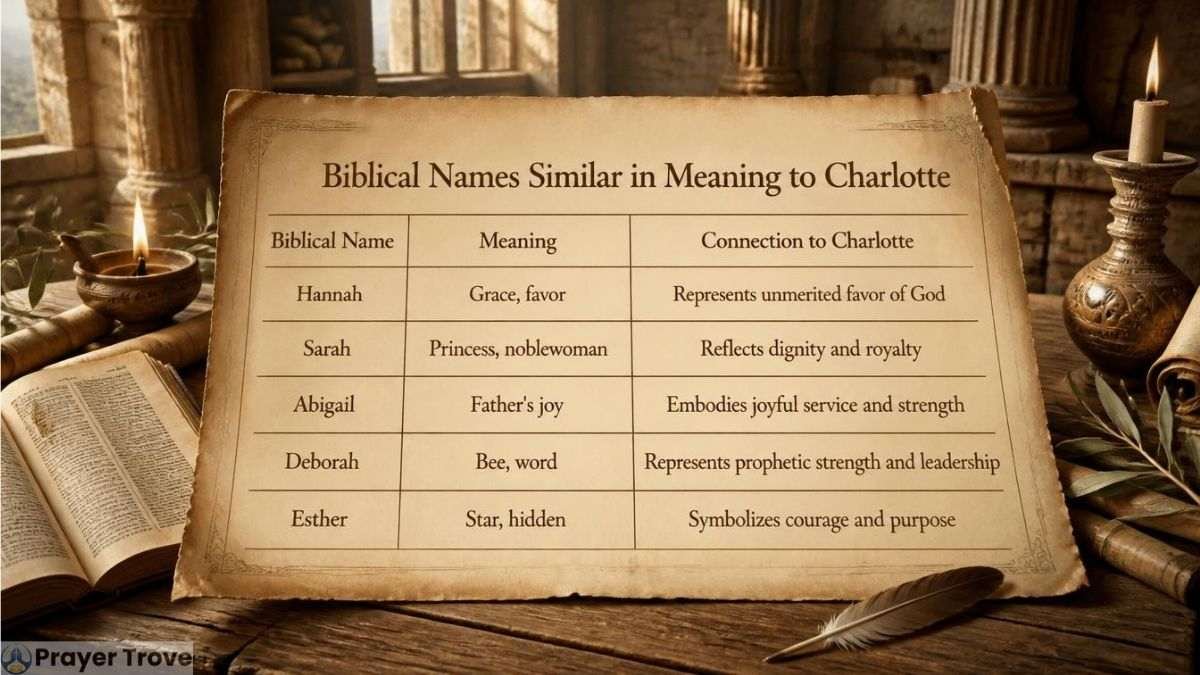
| Biblical Name | Meaning | Connection to Charlotte |
|---|---|---|
| Hannah | Grace, favor | Represents unmerited favor of God |
| Sarah | Princess, noblewoman | Reflects dignity and royalty |
| Abigail | Father’s joy | Embodies joyful service and strength |
| Deborah | Bee, word | Represents prophetic strength and leadership |
| Esther | Star, hidden | Symbolizes courage and purpose |
Hannah
Hannah means “grace” or “favor.” She appears in 1 Samuel as a woman of deep faith who prayed earnestly for a child. Her story demonstrates persistent prayer, sacrificial giving, and joy in answered prayers.
Hannah’s name parallels Charlotte’s connection to grace. Both names declare that the bearer receives God’s unmerited favor. Hannah’s faithfulness encourages believers to trust God with their deepest desires.
Sarah
Sarah means “princess” or “noblewoman.” She was the wife of Abraham and mother of Isaac, a matriarch of the faith. Her story in Genesis shows her journey of faith, including moments of doubt and eventual trust in God’s promises.
Sarah’s name mirrors Charlotte’s royal associations. Both names suggest dignity, leadership, and strength. Sarah’s life exemplifies the nobility that comes from trusting God.
Abigail
Abigail means “father’s joy” or “source of joy.” She appears in 1 Samuel as a woman of wisdom and beauty who intervened to prevent disaster. Her courage and diplomacy saved lives.
Abigail’s name shares Charlotte’s themes of wisdom and strength. Both names suggest women who act with courage and bring peace. Abigail’s quick thinking demonstrates the importance of wise action.
Other Biblical Names Associated With Grace
- Anna: Means “grace.” She was a prophetess who recognized Jesus as the Messiah and served faithfully in the temple.
- Eve: Means “life-giving.” She represents new beginnings and the grace of creation.
- Miriam: Means “bitter” but associated with strength. She led Israel in worship after crossing the Red Sea.
- Naomi: Means “pleasantness.” Her story in Ruth demonstrates the grace of redemption and restoration.
- Leah: Means “weary.” Despite her struggles, she received the grace of being part of God’s covenant lineage.
Conclusion
Charlotte means “free woman.” It holds special spiritual meaning for Christian families, even though it isn’t mentioned in the Bible. The name links to biblical ideas like freedom, strength, grace, humility, and faithfulness. This comes from its language roots and historical ties.
Parents choosing Charlotte for their daughter are making a declaration of faith. They hope she will find the freedom Christ offers. They want her to draw strength from God, walk in grace, serve with humility, and stay faithful all her life.
The name’s legacy features devoted women like Charlotte Elliott and Lottie Moon. Their lives showed its deep spiritual meaning. Their examples inspire the next generation to live with purpose and devotion.
Charlotte offers a timeless choice that combines elegance with spiritual depth. It is a name that can grow with a child and serve as a daily reminder of her identity in Christ.
Frequently Asked Questions
What does the name Charlotte mean in the Bible?
Charlotte does not appear in the Bible. Its meaning, “free woman,” connects to biblical themes of spiritual liberation. The name reflects freedom from sin and death through Christ, as described in Galatians 5:1.
Is Charlotte a biblical name?
No, Charlotte is not a biblical name. It does not appear in the Old Testament, New Testament, or apocryphal texts. Its origins are in Old German and Old French, deriving from Karl meaning “free man.”
What is the spiritual significance of the name Charlotte?
The spiritual significance includes freedom in Christ, strength through God, grace and dignity, servant-hearted humility, and faithfulness. The name symbolizes liberation from sin, empowerment by the Holy Spirit, and a calling to serve others.
Why do Christian families choose Charlotte?
Christian families pick Charlotte for its strong meaning, royal charm, and ties to biblical values. The name serves as a declaration of faith and a prayer for a daughter’s spiritual identity. Its legacy among faithful women also contributes to its appeal.
What nicknames can be used for Charlotte?
Common nicknames include Charlie, Lottie, Lotta, Char, Coco, and Lotte. These options provide flexibility for different life stages and personal preferences.
Does Charlotte have royal associations?
Yes, Charlotte has strong royal associations. Queen Charlotte of England (1744–1818) was known for her Christian values and charitable works. Princess Charlotte of Cambridge continues this royal connection in modern times.
Is Charlotte a good name for a Christian girl?
Yes, Charlotte is an excellent choice for a Christian girl. Its meaning of freedom, strength, and grace aligns with Christian values. The name carries a legacy of faithful women and serves as a daily reminder of identity and purpose in Christ.