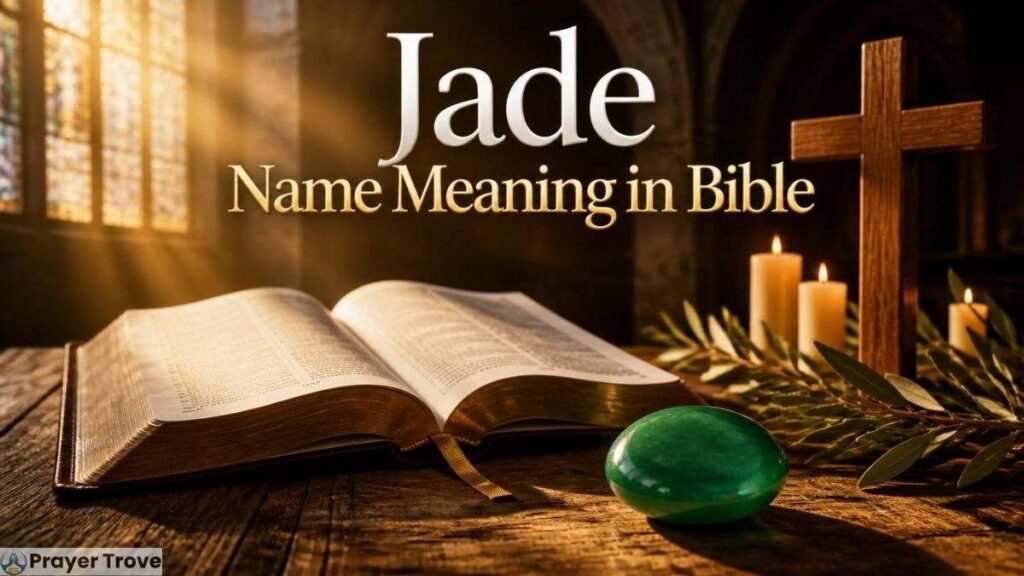
Many parents want a name with deep meaning. Jade is a popular choice, known for its beauty and calm sound. But does Jade have a place in the Bible? The short answer is no. The word “Jade” does not appear in Scripture. Still, the ideas behind the name — purity, wisdom, and worth — connect closely to biblical teaching. This article explains what the Bible really says about precious stones, and how those teachings relate to the name Jade.
What Is the Biblical Meaning of the Name Jade?
The name Jade does not come from a Hebrew or Greek word found in the Bible. It comes from a much later language, long after the biblical books were written. So Jade has no direct biblical meaning in the way that names like Sarah or David do. However, gemstones hold strong meaning throughout Scripture. Stones often stand for value, identity, and God’s presence among His people. Because of this, many people connect the name Jade to these broader biblical ideas, even though the word itself is absent from the text.
Origin and Meaning of the Name Jade
The origin of the name Jade
The name Jade comes from Spanish explorers in the Americas. They called the stone “piedra de ijada,” which means “stone of the side.” People once believed the stone could heal pain in the side of the body, especially kidney trouble. Over time, the name shortened to simply “Jade” in English. The name later became popular as a given name because of the gemstone’s beauty and its calm green color.
The literal meaning of Jade
| Detail | Description |
|---|---|
| Word Origin | Spanish |
| Original Phrase | Piedra de ijada |
| Literal Meaning | Stone of the side |
| Common Color | Green (also white or lavender) |
| Historical Use | Believed to heal the body |
Does Jade Have a Hebrew Meaning?
Is Jade a Hebrew name?
Jade is not a Hebrew name. It has no root word in the Hebrew language, and it does not appear in the Hebrew Bible. Names in the Old Testament usually carry meaning tied to Hebrew words, such as strength, praise, or gift. Jade simply does not fit into this pattern. Its roots are Spanish, not Hebrew, so any Hebrew connection is symbolic rather than linguistic.
Hebrew names with similar biblical meanings
| Hebrew Name | Meaning |
|---|---|
| Yakira | Precious or dear |
| Tehila | Praise |
| Chen | Grace or favor |
| Bracha | Blessing |
| Shira | Song |
What Does Jade Symbolize in the Bible?
The symbolism of precious stones in Scripture
While Jade is not named in the Bible, precious stones appear often and carry strong meaning. Stones represent value, beauty, and God’s care for His people. The Bible uses gemstones to describe holy items, like the High Priest’s clothing, and to picture God’s future kingdom. These stones were never random decorations. Each one pointed to something important, such as identity, honor, or divine glory.
Purity, wisdom, and spiritual value
- Stones often symbolize something set apart for a special purpose.
- Gemstones point to lasting value that does not fade.
- Bright, clear stones can represent purity of heart.
- Rare stones remind readers that God’s people are treasured.
- Stones used in worship connect beauty with holiness.
Bible Verses That Reflect the Meaning of Jade

Verses about wisdom
- Proverbs 8:11 teaches that wisdom is worth more than any jewel.
- James 1:5 encourages believers to ask God for wisdom when they lack it.
- Proverbs 3:15 compares wisdom to something more precious than rubies.
Verses about purity
- Psalm 51:10 is a prayer asking God to create a clean heart.
- Matthew 5:8 says those who are pure in heart will see God.
- 1 Timothy 1:5 links love with a pure heart and a clear conscience.
Verses about God’s treasured people
- Deuteronomy 7:6 describes God’s people as chosen and special to Him.
- 1 Peter 2:9 calls believers a chosen people who belong to God.
- Isaiah 43:4 says God sees His people as precious and honored.
Is Jade Connected to Biblical Gemstones?
Was Jade one of the High Priest’s breastplate stones?
Exodus 28:15-20 lists twelve stones placed on the High Priest’s breastplate. Each stone represented one tribe of Israel. Common English translations name stones such as sardius, topaz, emerald, sapphire, diamond, agate, amethyst, onyx, and jasper. Jade is not listed by name in the standard English translations of this passage. Some later writers or non-English versions use different stone names, which have led to confusion. But based on the widely used biblical texts, Jade was not one of the twelve breastplate stones.
Gemstones in the New Jerusalem
Revelation 21:19-20 describes twelve foundation stones in the New Jerusalem. These stones show the beauty of God’s future city.
| Foundation Stone | Common Color |
|---|---|
| Jasper | Clear or varied |
| Sapphire | Blue |
| Chalcedony | Grayish blue |
| Emerald | Green |
| Sardonyx | Red and white |
| Sardius | Red |
| Chrysolite | Golden green |
| Beryl | Sea green |
| Topaz | Yellow green |
| Chrysoprase | Green |
| Jacinth | Violet |
| Amethyst | Purple |
Jade is not named among these twelve stones in standard translations. Some of the stones listed, such as chrysoprase, share a similar green color to jade, which is likely why people connect the two.
Spiritual Meaning of the Name Jade
Faith and spiritual growth
Even without a direct biblical reference, the name Jade can still carry spiritual meaning for believers today. Jade forms slowly, under pressure, deep within the earth. This process can remind Christians of how faith grows over time, often through hard seasons. Just as a gemstone becomes valuable through a long process, spiritual growth also takes patience and trust in God.
God’s refining work in believers
- God often uses difficult seasons to build character.
- Growth in faith is usually slow, not instant.
- Trials can strengthen trust in God over time.
- A refined faith reflects steady, quiet growth.
- Patience during hard seasons often leads to spiritual maturity.
Is Jade a Good Christian Name?
 a
a
Biblical principles for choosing names
- Names in the Bible often reflect character or hope for the future.
- A name does not need to appear in Scripture to hold meaning.
- Parents can choose names based on values they want to encourage.
- A name can serve as a daily reminder of faith and identity.
- What matters most is the meaning a family gives the name at home.
Should Christians choose the name Jade?
Yes, Christian parents can choose the name Jade with confidence. While it is not a biblical name in origin, it is not against biblical teaching either. Many names used today, in many cultures, come from outside the Bible. What gives a name spiritual meaning is often the values a family attaches to it, not whether the word appears in ancient text. Jade can represent purity, strength, and quiet growth, values that fit well with a life of faith.
Lessons Christians Can Learn from the Name Jade
- True value often comes from what forms slowly and quietly.
- Purity of heart matters more than outward appearance.
- Wisdom is worth more than material wealth.
- God sees His people as treasured, not ordinary.
- Growth takes time, and that is not something to rush.
- A name can carry meaning without needing to appear in Scripture.
Conclusion
Jade is not a name found in the Bible, and it is not one of the stones named on the High Priest’s breastplate or in the New Jerusalem. Still, the ideas connected to Jade — purity, wisdom, and lasting value — appear clearly throughout Scripture. For Christian parents, the name Jade can carry real meaning, not because of ancient text, but because of the values a family chooses to build around it.
FAQs
Is Jade mentioned in the Bible?
No. The word “Jade” does not appear in standard English translations of the Bible.
Was Jade one of the twelve stones on the High Priest’s breastplate?
No. The breastplate stones listed in Exodus 28 do not include Jade by name.
Does Jade appear in the New Jerusalem in Revelation?
No. The twelve foundation stones in Revelation 21 do not list Jade directly.
What does the name Jade symbolize spiritually?
Jade is often linked to purity, wisdom, and steady growth, themes that also appear throughout the Bible.
Can Christian parents use the name Jade?
Yes. A name does not need biblical origin to hold spiritual meaning for a family.
Why do people think Jade is in the Bible?
Because Jade shares a similar green color with stones like emerald and chrysoprase, which are named in Scripture. This has led to some confusion over the years.